

Hummingbird Moth – Insect or Bird Newsletter


Newsletter
Hummingbird Moth – Insect or Bird?
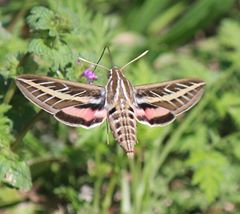
Photo by D. Compton
An interesting recent question:
Q: I had a very strange bug (?) visiting my yard. It looks like a cross between a moth and a hummingbird.
And another:
Q: I have a Meyers lemon tree full of blooms and this little guy went flying by my head, not shy at all, having a ball. Saw a picture someone sent in on Facebook to you. Can you give me information on this little bird? Never saw one before now and what a treat for me to see.
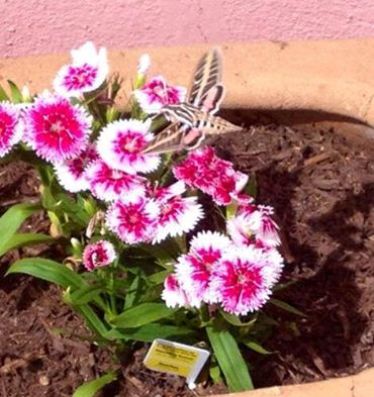
Photo by M. Ridgeway
It’s actually a very pretty moth.
Hummingbird Moth or Clearwing Moth
Hemaris thysbe
Description: Beautiful moths that look like hummingbirds. Wingspan 1 1/2-2″ (38-50 mm). Wings initially plum-red to brownish black, but scales drop off after 1st flight, leaving clear areas devoid of scales, except along veins. The body is spindle-shaped, mostly olive-green with plum-red bands across abdomen and rear tufts. Caterpillar is yellowish green with darker green lines and reddish-brown spots on abdomen and with yellow tail horn.
Life Cycle: Caterpillar feeds on foliage of plants of the honeysuckle family and others.
Flight: April – September.
Habitat: Forest edges, meadows, and cultivated flower gardens.
Range: Coast to coast in the North; also east of the Great Plains south to the Gulf.
Discussion: This moth hovers over flowers in full sunlight, producing a buzz with its wings similar to but softer than that of a hummingbird similarly engaged. There are two generations a year.
Life History: Adults fly during the day, and hover at flowers to sip nectar. Caterpillars pupate in cocoons spun at the soil surface.
Flight: Two broods in the south from March – June and August – October, one brood in the north from April – August.
Caterpillar hosts: Honeysuckle (Lonicera), snowberry (Symphoricarpos), hawthorns (Crataegus), cherries and plums (Prunus), and European cranberry bush (Viburnum opulus).
Adult food: Nectar from a wide variety of plants including Japanese honeysuckle, beebalm, red clover, lilac, phlox, snowberry, cranberry, blueberry, vetch, and thistles.
Habitat: Open and second-growth habitats, gardens, and suburbs.
Range: Alaska and the Northwest Territories south through British Columbia to Oregon; east through the Great Plains and the Great Lakes area to Maine and Newfoundland; south to Florida and Texas.
Here’s an excellent site for more information on this wonderful insect.
http://www.silkmoths.bizland.com/hthysbe.htm