

Algae Control
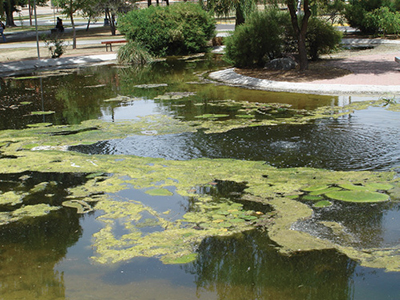
For floating paint-like and filamentous algae in water, use cornmeal at 5 pounds per 1,000 square feet or 150-200 pounds per surface acre. The cellulose in the cornmeal helps to tie up the excess phosphorous in water, balances the water chemistry and thus kills off the algae. The organic carbon in the cornmeal enables the beneficial bacteria in the water to flourish at the expense of the algae. Then the decomposing algae provide a source of carbon for the bacteria. One or two treatments is usually enough to control the algae for several months. Getting the cornmeal to the bottom of the water increases the effectiveness. One technique is to put in a burlap bag with a rock. Small water features can use cornmeal in mesh bags. Pelletized cornmeal is good because it sinks.
Caution: any fast algae kill from any product can cause an oxygen deprivation and result in fish kill.
Additional information can be obtained from the following publication:
Aquaculture Engineering,(1990) Vol 9, Issue 3, p.175-186.*
P.S. Cornmeal only works in an organic program. When toxic chemical products are used, the effect of the cornmeal will be lost.
CORN GLUTEN MEAL – It does not have the same disease fighting qualities. It is the natural “weed and feed” fertilizer. See separate entry for details.
*The journal Aquaculture Engineering is behind a paywall and the article is old enough it is difficult to load from modern university databases. If you wish to pay Elsevier/Science Direct for a PDF, the DOI is https://doi.org/10.1016/0144-8609(90)90004-J
Here is the Abstract:
Control of high pH in aquacultural ponds
Authors: J.W. Pote, T.P. Cathcart, P.N. Deliman
Abstract
Tests were conducted to determine the effectiveness of calcium sulfate, calcium chloride, calcium carbonate, acetic acid, and ground corn for the control of high pond pH. The tests were conducted in 24 9400 liter pools. Salts of calcium did not significantly reduce daily maximum pH relative to control pools, although mean pH levels were consistently less than control values at higher application concentrations. Acetic acid did not effectively control pH at the level tested. Application of ground corn did significantly reduce pH at all levels tested. Use of ground corn has become a routine management strategy for pH control in shrimp ponds at Mississippi State University.