

Frequently Asked Questions
157 questions and answers from Howard Garrett's organic gardening library, organized by category.
Trees & Shrubs
Do root flare rules apply the same way to grafted trees?
How do you eliminate Spanish moss or ball moss while saving the tree?
Use my Sick Tree Treatment, which begins with exposing the tree’s root flare. Physically remove as much moss as possible and spray the tree with a commercial product called Bio Wash (add 1/4 cup of baking soda or potassium bicarbonate per gallon of spray).
Flowers, Herbs & Edibles
When is the best time to prune or cut back plants?
I would cut the stalk off now and hang it upside down for a month or so to allow it to dry thoroughly. It should last a long time as a dried flower. No other treatment should be needed.
Why do flowers change color?
Garden writers and other “experts” say the flowers of plants cannot change color – except for hydrangeas.. In Dallas’ alkaline soil, hydrangea blooms are pink. It’s an old-fashioned custom to apply acidic amendments regularly to the soil at the base of the shrub to produce blue flowers Big-leaf hydrangeas, the ones with large showy flowers (actually bracts) are said to stand alone in ability to change bloom color. In acidic soil (pH below 5.5), hydrangeas produce blue flowers. In neutral to alkaline soils (pH of 6.5 and higher), flowers are usually pink – supposedly because higher pH makes aluminum in the soil unavailable to the plant. My experience is that changing the color of these plants by adjusting soil amendments is possible, but mostly the results turn out to be a rather dull color somewhere between blue and pink.. Related to other plants, some horticultural geniuses say it’s just a figment of the imagination that flowers can change color – doesn’t happen in nature and can’t happen in your garden. That’s not true. Flowers can definitely change color, but it is a little difficult explaining how it happens. . Doubters will say that if an iris or any other plant changes color, it could be a combination of things or simply a random accident, but it’s not the plant actually changing color. Attempted explanations range from a rogue rhizome of white irises getting in the blue/purple iris bed and taking over to you just forgetting what you planted and where.. Some will admit that flowers can have a slight color change or loss of color, due to extreme temperature changes or a change in light conditions because the nearby trees got bigger. Deep purple irises commonly turn a lighter color when maturing and starting to die. It is also said that these color changes usually revert back over time and the plant will resume its usual color. Unexplained instances of an entire bed that was purple turning white the following year just can’t happen they say. But it can. Happened at my office. When we bought the place, the iris bed in the front yard was all blue/purple. The year later it was all solid white – and I didn’t do anything to the bed other than start fertilizing with the organic fertilizers I use generally.. Crinum lilies can change color from one season to the next Several of my listener/readers have reported similar cases and results. My buddy and co-organic-conspirator on the radio in San Antonio, Bob Webster, has had personal experience and many reports from others about this curious flower color change. . The case that confirmed my strong suspicions happened in my own back yard. Bright pink crinum lilies where planted in early spring and bloomed that first summer with gaudy hot pink flowers. The next season they were white with pink stripes and for the last five seasons they have bloomed a beautiful pure white. . Don’t try to figure it out – just enjoy it..
Can you determine the sex of a tree before planting it?
A. It is scientifically possible to determine whether a young Ginkgo biloba tree is male or female, but a DNA test would be far too expensive for routine use.. https://www.nytimes.com/2002/10/01/science/q-a-avoiding-ginkgo-fruit.html. From: Arboriculture & Urban Forestry (link downloads a PDF file to read) The ginkgo (Ginkgo biloba) has been a popular landscape tree in the United States ever since its introduction in 1 784. Aside from the selection and propagation of male cultivars (5), there has been relatively little practical research in ginkgo in recent years, probably because most of the planted trees existed in streetside locations or as scattered individuals. Therefore, we were most anxious to take advantage of a unique opportunity to study a forest-type planting of ginkgo.. http://joa.isa-arbor.com/request.asp?JournalID=1&ArticleID=1891&Type=2. From: Houzz (topic & thread discussion) I used to specify Ginkgo a lot. It seems that it is billed as the next saving grace for urban streetscapes and difficult sites. But after watching them grow, I am less impressed. Sure, I see the occasional large and grand Ginkgo in a yard or park, but most of them used in streetscape scenarios often disappoint. They are slow to grow and often spindly. If they get ANY mower/weedwacker damage then that will slow them down even more. The biggest disappointment is seeing 20% or so of the “certified male” trees begin producing fruit after 6 or so years. No one wants to smell that vomit odor when window shopping on that main street retail sidewalk. Then the shop owner is pushing the City or landlord to remove the tree. All this has pushed me to stop using this tree most of the time.. https://www.houzz.com/discussions/1726485/anyone-had-a-certified-male-ginkgo-produce-fruit.
Can corn gluten meal kill horseherb if applied too heavily?
Why is my plant not thriving despite good soil and full sun?
When is the best time to separate red yucca pups from the mother plant?
Lawn & Weed Control
How much area does one bottle of AgraLawn Crabgrass Killer cover?
Why does AgraLawn Crabgrass Killer turn yellow after watering?
Why does AgraLawn crabgrass killer need to be "activated"?
How do I activate AgraLawn Crabgrass Killer after applying it?
How do I wet the area before applying AgraLawn Crabgrass Killer?
How long should I "not disturb" the product after it turns yellow?
After applying AgraLawn Crabgrass Killer, what does "leave the area undisturbed" mean?
When using AgraLawn Crabgrass Killer, what does "evenly treated" mean?
Is AgraLawn crabgrass killer temperature sensitive?
Do you have any tips to help me save money on your product?
Using AG Crabgrass Killer
When used properly, AG causes very little reaction or yellowing to St. Augustine or Bahia lawns. Applying during the a.m. hours while morning dew is present works best, or you can wet the affected area with a hose, irrigation or spray bottle.
Apply only to the affected area, being careful to dust all of the weeds and/or weed grass you want to control. This product will turn from white to a bright yellow when applied to indicate adequate moisture is present. Apply a light to medium coating in even strokes. Noticeable results should be seen in 3 to 5 days. To avoid washing away product, don’t apply if rain is forecasted or directly before watering the lawn. Reapply as needed.
Are 2,4-D and Broadleaf herbicides too toxic?
The herbicide, 2,4-D is used to kill broad-leaf plants on millions of household lawns, golf courses and and playing fields. About 46 million pounds of the chemical is used each year, about 35% of which is used on parks, golf courses, home lawns and other non-agricultural uses.. According to Beyond Pesticides, 2,4-D has been linked to “non-Hodgkin’s lymphoma, endocrine disruption, reproductive and developmental effects, as well as water contamination and toxicity to aquatic organisms.” Organic agriculture and lawn care can effectively replace the chemical, according to the group.. To learn more, check out the information published by Beyond Pesticides. . ANOTHER IMPORTANT REASON TO AVOID WEED KILLERS. The past 25 years have seen a 740% increase in bladder cancer among dogs. This disturbing FACT led veterinary specialists to commission a study on possible causes. The study showed no connection to flea control products or various environmental toxins, but showed an absolute link to herbicides. Both 2,4-D type herbicides (broadleaf weed killers) and herbicides of the type used in weed and feed products were shown to be definite cancer causers. Although these types of products are still on the market and have been approved by the FDA, they are definitely not safe. Scientific studies such as this provide proof.. Please do not use these or any other toxic chemicals in your landscape. They are dangerous and unnecessary.. This topic originally led to a 2009 survey to ban the sale of 2,4-D. It has been updated to provide general information..
What can you do if you can't grow grass in a shady yard?
Try These Pretty Ground Covers.
How do you grow grass in heavy shade?
Sorry, it can’t be done. Trees and grass both need the sunlight. Trees win! There is a solution though: shade-loving ground covers. Hard surface materials such as decomposed granite, flagstone, lava gravel and natural mulches can also be used along with shade-loving shrubs, ferns and other plants. But turf grasses just won’t cut it.
Here are the best choices for North Texas.
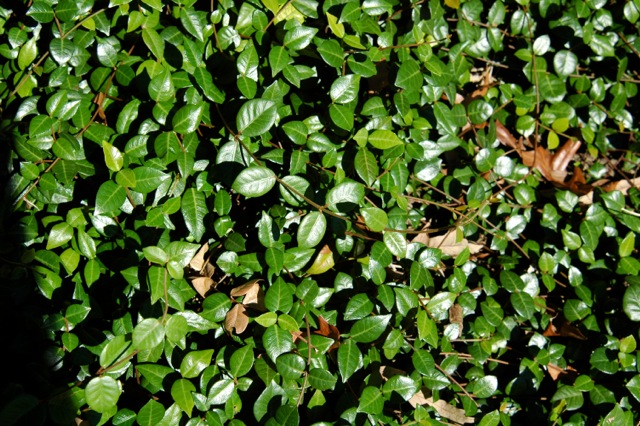 Asian jasmine is probably the best choice for ground cover |
Asian jasmine is possibly the best choice of all these ground covers. It is evergreen, dense, low growing, with small, shiny, oval leaves, no flowers, and will climb but not readily. It needs moist, well-drained, well-prepared soil, but once established it is quite drought-tolerant. It should be cut down by mowing at the highest setting in late winter and again in July if wanted. Under the organic program, winter damage ranges from none to slight burning of tip growth.
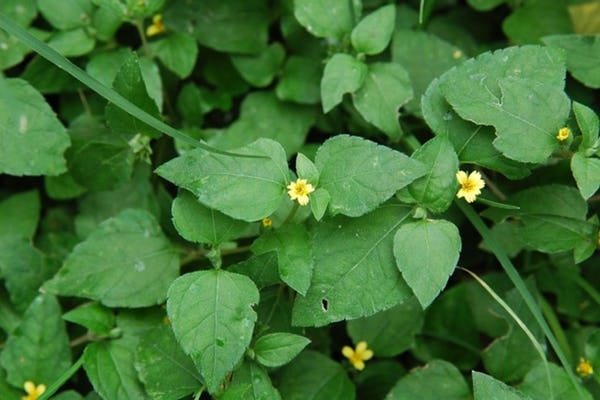 Horseherb |
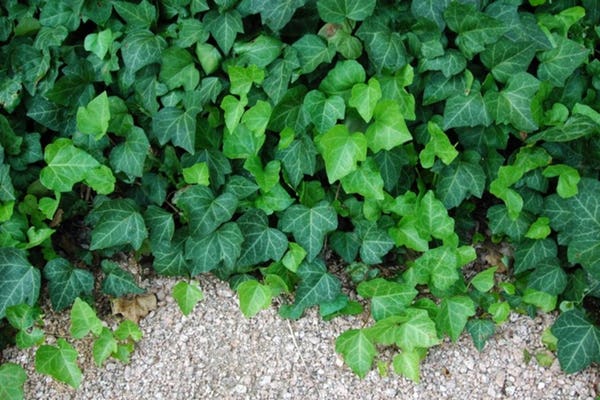 English Ivy |
English ivy is a relatively fast-growing evergreen for shade to part shade. It will climb most any surface. It needs good bed preparation, good drainage and mulch for establishment. ‘Needlepoint’ and ‘Hahn’s’ ivy are smaller leafed cultivars. The variegated form is good to use with flowering plants.
Horseherb is a deciduous to semi-evergreen native ground cover for shade to part shade. It has ever-blooming tiny yellow flowers and is easy to grow in any soil. It freezes to the ground some winters but returns each spring. It is drought-tolerant, pest free and looks terrific when planted with wild violets. Some people unfortunately consider it a weed.
Liriope, aka monkey grass and lilyturf, is an evergreen ground cover for sun or shade. Its grasslike clumps spread by underground stems to form solid mass planting. It has blue flowers on stalks in early summer. It can be cut down in late winter just before the new spring growth, but it’s not critical or even recommended. It is easy to divide and transplant anytime.
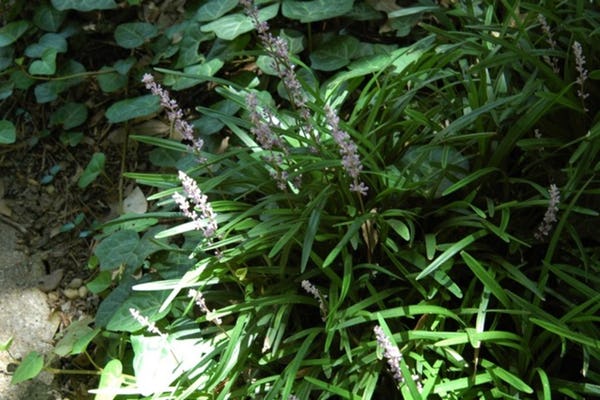 Lirope |
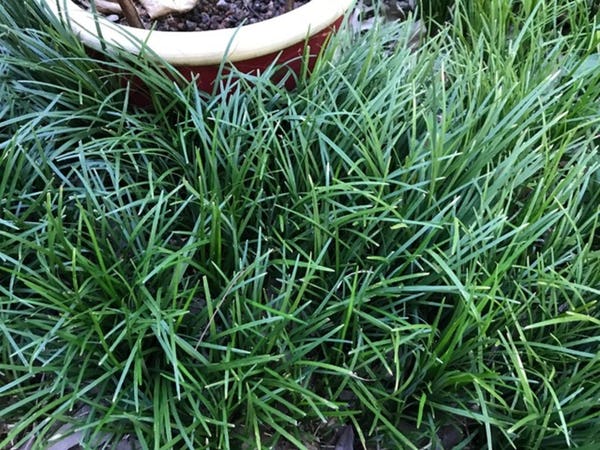 Ophiopogon |
Ophiopogon, aka mondograss, is an evergreen low-growing, grass-like ground cover for shade or part shade. It grows in clumps but spreads by rhizomes to form a solid mass. It needs even moisture and regular fertilization, and can be mowed occasionally for more of a turf look, but it’s not necessary. A dwarf form of this plant is very compact, dark green, and slow growing.
 Persian Ivy |
Persian ivy is a wonderful evergreen ground cover for shady areas. It’s just as cold-tolerant as English ivy but less susceptible to diseases. It’s also more drought-tolerant than English ivy, but not as easy to find in nurseries. It’s one of my favorite ground covers but it does have a fatal flaw. It cannot stand any direct sun.
There are some other choices, but they are not as forgiving as the ones mentioned.
Is creeping Charlie a nice groundcover or an invasive weed?
Once again – it’s both. This is a groundcover that I have used myself and recommended for many years. I’ve even covered it in my plant books. On the other hand many gardeners consider it a problematic weed. It is very easy to plant and establish if you want it and it is an edible herb. It is also easy to invade where not invited and hard to get rid of if you don’t want it. Click the button below for all the details you need to know about this Jekyll and Hyde plant..
What can I do to help the soil hold more water?
How do I kill all remaining grass roots, to prep for flower garden?
Answer: . Roots of the grass do not have to be removed. Only the stems, rhizomes and stolons have reproductive ability. Do not till first – that drives the reproductive pieces into the ground and causes a long term weed problem. Scrape or set the sod cutter to a depth of 1/2 to 2″ and throw that material in the compost pile. Mixed with leaves and other materials, the grass will be useful in the composting process. Next mix in all the organic amendments. Here’s the detailed description: .
How do you encourage growth in plants that are not thriving?
Is there a herbicide that will kill bermuda grass roots?
Thank you for your help. G. G. Seguin, TX. A. The vinegar herbicides such as the Good Natured product and the fatty acid products such as BioSafe will kill Bermudagrass but sometimes have to be sprayed more than once. If the grass has been tilled prior to attempted removal, the buried pieces of rhizome will attempt to come back forever. In that case, the only solutions are to dig it all out or use the smoother technique. To smoother the weeds, apply dry molasses at about 2 lbs per 100 sq ft. Then cover the molasses with 1/2″ of compost, followed by 3-5 layers of newspaper or butcher paper. One layer of cardboard will also work. Wet each layer thoroughly as it goes down. The final step is to cover it all with at least 2″ of shredded native tree trimmings..
How can I grow grass under my big shade trees?
” The answer – it can’t be done. Trees and grass both need the sunlight and trees always win! There is a solution though: shade-loving ground covers. Hard surface materials such as decomposed granite, flagstone, lava gravel and natural mulches can also be used along with shade-loving shrubs, ferns and other plants. But turf grasses just won’t cut it.
Here are the best choices for North Texas.
Asian jasmine is possibly the best choice of all these ground covers. It is evergreen, dense, low growing, with small, shiny, oval leaves, no flowers, and will climb but not readily. It needs moist, well-drained, well-prepared soil, but once established it is quite drought-tolerant. It should be cut down by mowing at the highest setting in late winter and again in July if wanted. Under the organic program, winter damage ranges from none to slight burning of tip growth.
For a relatively fast growing evergreen, consider English ivy for shade to part shade. It will climb most any surface. It needs good bed preparation, good drainage and mulch for establishment. ‘Needlepoint’ and ‘Hahn’s’ ivy are smaller leafed cultivars. The variegated form is good to use with flowering plants. (Don’t let ivy grow up your trees, it isn’t good for them.)
Horseherb is a deciduous to semi-evergreen native ground cover for shade to part shade. It has ever-blooming tiny yellow flowers and is easy to grow in any soil. It freezes to the ground some winters but returns each spring. It is drought-tolerant, pest free and looks terrific when planted with wild violets. Some people unfortunately consider it a weed but it is growing in popularity.
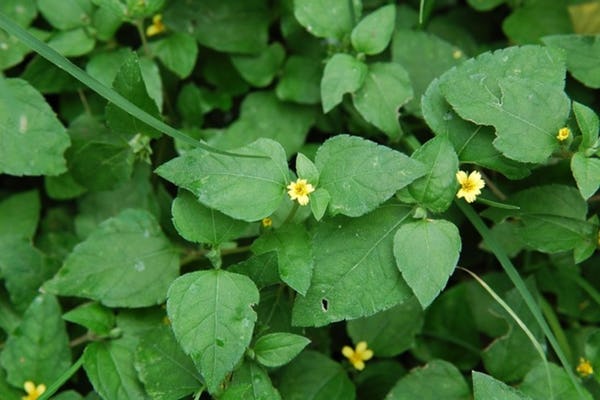
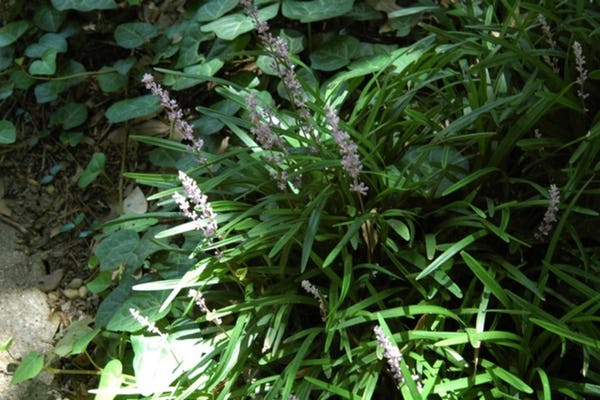
Horseherb (left) and Liriope (monkey grass)
Liriope, aka monkey grass and lilyturf, is an evergreen ground cover for sun or shade. Its grasslike clumps spread by underground stems to form solid mass planting. It has blue flowers on stalks in early summer. It can be cut down in late winter just before the new spring growth, but it’s not critical or even recommended. It is easy to divide and transplant anytime.
Ophiopogon, aka mondograss, is an evergreen low-growing, grass-like ground cover for shade or part shade. It grows in clumps but spreads by rhizomes to form a solid mass. It needs even moisture and regular fertilization, and can be mowed occasionally for more of a turf look, but it’s not necessary. A dwarf form of this plant is very compact, dark green, and slow growing.
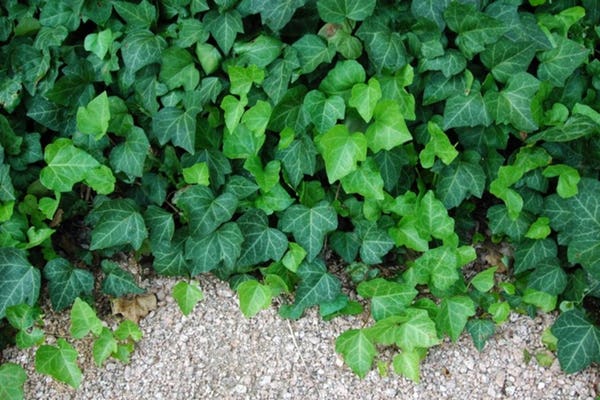
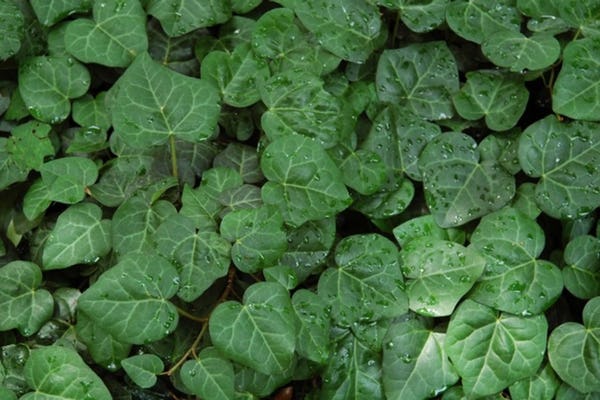
English ivy (left) for full or part shade. Persian ivy (right) for full shade only
Persian ivy is a wonderful evergreen ground cover for shady areas. It’s just as cold-tolerant as English ivy but less susceptible to diseases. It’s also more drought-tolerant than English ivy, but not as easy to find in nurseries. It’s one of my favorite ground covers but it does have a fatal flaw. It cannot stand any direct sun.
There are some other choices, but they are not as forgiving as the ones mentioned.
What organic weed control methods are recommended?
How do you deal with nutgrass problems?
Control it with Liquid Molasses. Nutsedge Cyperus esculentus or Cyperus rotundus. Nutsedge or nutgrass (not a grass and it has no nut) is a persistent weed that happily spreads through gardens and turf and is difficult to kill. Instead of chemicals, killing it with love seems to work. Pouring liquid molasses into your watering can instead of orange oil or vinegar does the trick. Here’s how.. Use liquid horticultural molasses. Drench problem spots with liquid horticultural molasses at ¼ to ½ cup per gallon of water. Start with about a gallon of drench per every 9-10 square feet. This simple technique fires up the microbes in the soil and the nutgrass simply fades away. It takes a while to work and requires at least 2 – 3 applications. As opposed to toxic chemicals, it makes the soil heathier with every application.. It may take 2 or 3 treatments After You can spot spray with the Avenger product to speed up the process if turf and other good plants can be avoided. (Avenger is a broad spectrum herbicide that will kill everything.) Physically removing the damaged weeds obviously also speeds up the process.. Read more about Nutgrass. And finally here’s an interesting report on using this technique.. You suggested that we use molasses to stop nutgrass. We tried it and it did not kill the nut grass. Thought I had made a mistake until I dug it up and low and behold — NO NUTS in the nutgrass. The molasses stopped the development of the nodes that stay in the ground when you pull up the plants. It worked! Just thought I would pass that discovery on! M.A., Rowlett . Thanks very much for the report. That explains why it takes more than one application of the molasses to kill the tops.. Beyond the use of molasses or chemicals, or in addition to, there are also some tools ideally suited to removing nutsedge if it has established itself in the good soil of a garden or if it is growing in sand or pea gravel. Try the stirrup hoe. Discussed in several Dirt Doctor topics here to do with hand tools, the stirrup hoe is ideally suited to pull the nutsedge free of the garden or gravel without digging. It is also called the “push pull” hoe.. Stirrup hoe. .
Is ragweed or goldenrod the real allergen?
Here is a question that I get asked often.. Q. My allergies have really been bothering me lately. I noticed that goldenrod is in bloom and wondered if that was the culprit.
Should you keep goldenrod from blooming to reduce allergies?
A. Allergies are bad this year but goldenrod is not the problem. Goldenrod has heavy pollen that doesn’t blow around and cause allergies. It is simply a beautiful wildflower and excellent for attracting beneficial insects including the pollinators. The bad plant and the culprit in this case is ragweed, both common ragweed and giant ragweed. Its white flowers do have some positive attributes but probably more negatives..
Is spiderwort a desirable flower or a weed?
The answer is both. Virginia spiderwort is an effective, colorful perennial that behaves itself quite well. The tropical spiderwort doesn’t behave itself, isn’t very pretty and quickly becomes an invasive weed.
What are the most troublesome weeds in the US?
What’s the most troublesome weed in the U.S.?
It’s now official. A survey conducted by the Weed Science Society of America (WSSA) has ranked Palmer amaranth, also known as Palmer pigweed, as the most troublesome weed in the U.S. Weeds in the Galium genus (cleavers, catchweed bedstraw and false cleavers) ranked as the most troublesome in Canada.
“We certainly weren’t surprised to find Palmer amaranth at the top of the U.S. list,” says Lee Van Wychen, Ph.D., science policy director for WSSA. “This weed can have a devastating impact on crop yields. Its stems are tough enough to damage rugged farm equipment, and it is extremely prolific. A single Palmer amaranth plant can produce as many as a million seeds during a growing season.”
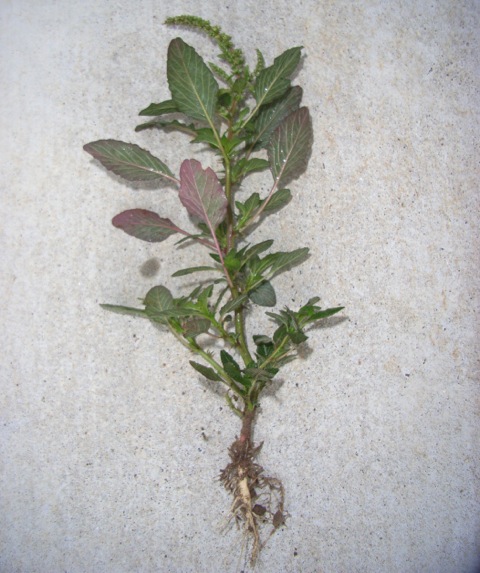
Photo Credit: Botanical Research Institute of Texas
Pigweed (Palmer Amartanthus)
Hundreds of weed scientists, Extension agents and practitioners across 49 U.S. states, Puerto Rico and eight Canadian provinces participated in the 2015 WSSA survey. They provided input on both the most common weeds (those most frequently seen) and the most troublesome weeds (those most difficult to control) in 26 different cropping systems and natural areas. The lists below are based on an aggregation of their responses, which mentioned more than 650 weeds at least once.
| Most Troublesome Weeds, U.S. | Most Common Weeds, U.S. |
| 1. Palmer amaranth | 1. foxtail (giant, green, yellow) |
| 2. morningglory (ivyleaf, pitted, tall, sharppod) | 2. common lambsquarters |
| 3. common lambsquarters | 3. crabgrass (large, smooth) |
| 4. waterhemp (common, tall) | 4. Palmer amaranth |
| 5. horseweed (marestail) | 5. morningglory (ivyleaf, pitted, tall, sharppod) |
Three weeds – common lambs quarters, morning glory species and Palmer amaranth – appear on both lists above.
For Canada, weed species in the Alberta, Saskatchewan and Manitoba prairies tended to dominate the survey. Wild buckwheat and wild oat appeared on both the “most troublesome” and “most common” lists.
| Most Troublesome Weeds, Canada | Most Common Weeds, Canada |
| 1. Galium (cleavers, catchweed bedstraw, false cleavers) | 1. wild buckwheat |
| 2. wild oat | 2. wild oat |
| 3. Canada thistle | 3. pigweed (redroot, smooth) |
| 4. kochia | 4. foxtails (green, yellow, giant) |
| 5. wild buckwheat | 5. common lambs quarters |
Among the other significant findings from the 2015 WSSA survey were the most troublesome and the most common weeds in several key crops and ecosystems across the U.S. and Canada:
| Crop/Ecosystem | Most Troublesome Weed | Most Common Weed |
| Aquatic systems | hydrilla | watermilfoil (Eurasian, hybrid) |
| Cereal grains, spring | wild oat | wild oat |
| Cereal grains, winter | downy brome/cheatgrass | downy brome/cheatgrass |
| Corn | waterhemp (common, tall) | foxtail (giant, green, yellow) |
| Cotton | Palmer amaranth | Palmer amaranth |
| Parks, wildlife refuges | Canada thistle | downy brome/cheatgrass |
| Forestry | Japanese stiltgrass (Mary’s-grass, Nepalese browntop) |
Japanese stiltgrass (Mary’s-grass, Nepalese browntop) |
| Fruit and nut crops | Eastern poison-ivy | red sorrel |
| Pastures, rangelands, right of ways | Canada thistle | Canada thistle |
| Soybean | horseweed (marestail) | foxtail (giant, green, yellow) |
| Turf | annual bluegrass | crabgrass (large, smooth) |
| Vegetables | nutsedge (yellow, purple) | common lambsquarters |
The 2015 survey data is available at http://wssa.net/wssa/weed/surveys. Scientific names for the weeds above are available in the WSSA composite list of weeds at http://wssa.net/wssa/weed/composite-list-of-weeds.
WSSA plans to conduct its weed survey annually, with a three-year rotation of different weed habitats. The 2016 survey focuses on weeds in broadleaf crops, fruits and vegetables. The 2017 survey will focus on weeds in grass crops, pastureland and turf, while the 2018 survey will focus on weeds in aquatic environments, natural areas and other noncrop settings.
Source: The Weed Science Society of America
Recommended control: This and many other tough undesirable plants are best controlled with physical removal and the use of vinegar and fatty acid products on regrowth.
Maintenance
Is there an organic alternative to chemical treatments for borers?
A: The chemical injections will just weaken the tree. I would only do the Sick Tree Treatment. Borers only attack trees that are in stress. Relieve the stress and the pests go away.
Here’s a link to some good basic information on borers – http://www.ext.colostate.edu/PUBS/INSECT/05530.html
Can You Cut Your Neighbor's Tree if it's Over Your Yard?
Trees growing on your neighbors’ property aren’t yours, but the damage they might cause to your property can be your problem.. If neighbor’s tree limbs have reached out over your roof, they can be a risk and the neighbor can be responsible. Fallen tree limbs are among the leading causes of roof damage in some states. They can also be dangerous to people, pets and cars. Although most homeowners insurance policies do not cover preventative tree removal, pruning or other tree care, trimming tree limbs properly can sometimes save a lot of money in the long run.. Tree limbs can extend long distances and cross property lines.
What if my neighbor's tree falls across my property line?
However, just because tree limbs have reached over your property line doesn’t mean the tree is yours to trim as you wish. If the trunk is in your neighbor’s yard, the tree belongs to them.. Your neighbor is liable for any damage caused by their tree when limbs, branches or the entire tree falls on your property. You usually would have to prove that negligence on their part caused “serious harm” to buildings or other parts of your property – unless they just agreed. If the tree was decayed, diseased, dead or in any dangerous condition before a natural disaster, it would probably also be their responsibility.. Your neighbor is not normally responsible for damages that qualify as an “act of God,” according to most state law. This in many cases would mean if the tree was healthy before a natural disaster caused the tree to fall and cause “serious damage,” the tree owner would not liable.. In some cases when a neighbor is unwilling to trim their trees from your property, you can also sue to make them cut the branches even if no harm has yet been done.. You are generally allowed to trim your neighbor’s tree branches back to your property line as long as you stay out of your neighbor’s property (unless permission is granted) and don’t cause great damage to the tree that throws it into stress and/or leads to its death. But be careful. If it could be proven that you killed the tree by incorrect or overdone trimming without permission, you could owe the homeowner compensation for harm done. Loss of large trees can significantly lower property value.. Nothing is “cut and dried” on this subject. If your neighbor’s trees appear to be a risk for your property, I strongly recommend hiring a professional arborist to give you an evaluation. Discussing the situation with the neighbors first can often be the best first step. They might just solve the problem for you.. And by the way – this reasoning applies to your trees growing out over your neighbor’s property as well.. .
Can I add the crabgrass that I pull from my lawn to the compost pile?
QUESTION: Something is destroying my St. Augustine lawn. I’m guessing that it is a fungus such as brown patch. I am using a heavy application of cottonseed meal, a remedy you have suggested. It worked well in the past but not this time. I also made a second application of a garlic fungicide, which seems to have helped a little. T.R., Fort Worth
ANSWER: Fall is the perfect time to apply a 1/2-inch layer of compost to the entire lawn. This will do more good than anything else.
What kind of tree is best to plant in a large yard, and when?
How do you get rid of unwanted plants or weeds organically?
Answer: There are no organic or chemical sprays that are effective in controlling mistletoe. On the other hand, it can be controlled by other methods.
Mistletoe infests trees that are weak. Weakness in the immune systems of trees results from several factors. Some varieties have genetic problems. Hackberries, for example, almost always have a lot of mistletoe. Other trees such as elms and oaks get mistletoe infestation and other parasites because of stress caused by improper planting, too much or too little water, too much or the wrong kind of fertilizer, soil compaction, soil contamination or the use of chemical pesticides. Here’s the plan: Prune the mistletoe out of the tree. Remove infested limbs completely if it can be done without ruining the shape of the tree. Carefully notch into large limbs that can’t be removed to cut away the mistletoe.
I used to say that this is the only place I recommend the use of pruning paint. That was a dumb recommendation. Pruning paint and toxic wound dressings should never be used. At the most, slather a little of my “tree trunk goop” onto the pruning wound. Find the recipe via www.dirtdoctor.com/home.php.
Will the new tree planted in the same place get the disease?
A. It was probably cotton root rot instead of Dutch Elm disease. Lacebark elms have been pretty well proven to be a bad choice in soil that has had cotton grown on it in the past. No problem planting in the same place but I would switch to Chinese pistachio, shantung maple or one of the natives like Texas red oak, Texas ash, native pecan, bur oak or chinkapin oak.
How can I keep my greenhouse in good condition before trouble starts?
Is it possible to grow a particular plant outside its usual climate zone?
Could this be fire ants and what can I do about it?
Does removing bark damage the tree during root flare exposure?
How and when should I prune apricot trees?
Does decomposing get rid of antibiotics, steroids, etc?
Is there a difference between corn gluten meal, cornmeal, horticultural cornmeal and Aunt Jemima and Martha White's cornmeals?
Cornmeal ’– starchy endosperm of corn. The outside edge of the corn kernel has been removed.
Aunt Jemima ’– the most effective grocery store cornmeal for horticultural use.
Whole ground corn ’– the entire corn kernel ground into a meal. Very effective, especially if organically grown.
Corn gluten meal ’– the protein fraction of the corn kernel. Powerful natural weed and feed product. Not for disease control.
White corn vs. yellow cornmeal ’– not sure which is more effective. Most of my work has been done with yellow cornmeal.
How often should I apply Garrett Juice, and what is the application rate for vinegar herbicide?
When should wrapped trees be unwrapped, and what about pruning and fertilizer?
The hardy palms don’t have to be wrapped at all. In your case, I would probably remove the wrapping because it really doesn’t protect the tropical palms anyway. Now is the time to apply organic fertilizer and any of the locally available choices will be fine. Cut the brown leaves off, they are dead and won’t come back. Hopefully your plants aren’t damaged too much. If you have to replant, the choices that didn’t even have cosmetic damage include sabal, pindo, needle, Japanese windmill and Mediterranean palms.
When grass starts greening in spots, can I apply pre-emergents?
What ongoing care does an organic garden need?
Soluble Solids and Taste Preference of 14 Pomegranate Varieties
What's the big deal about pomegranates? Is it true they have medicinal properties?
Modern research shows that pomegranates contain compounds such as tannins and antioxidants that can have beneficial effects on the cardiovascular system and prostate gland.
Research published in September in the American Journal of Cardiology showed that 45 heart disease patients who consumed one glass of pomegranate juice daily for three months had improved blood flow to their hearts. According to Dr. Dean Ornish, pomegranate juice may reverse heart disease through its ability to inhibit plaque buildup in arteries.
Pomegranate juice may also be beneficial to men with erectile dysfunction due to clogged blood vessels. A study published in the Journal of Urology in July 2005 found that antioxidants found in pomegranate juice, along with other drinks high in antioxidants like blueberry juice, cranberry juice, orange juice, and green tea, improved erectile response.
In September 2001, a study published in the journal Atherosclerosis showed that some antioxidants in pomegranate juice could reduce blood pressure through their ability to affect the activity of an enzyme called “serum angiotensin converting enzyme.”
(Note: Some pharmaceutical drugs reduce blood pressure by inhibiting this same enzyme.)
Men with prostate cancer may also benefit from pomegranate juice. Researchers at the University of Wisconsin found that pomegranate extract may prevent prostate cancer or slow its growth. Their findings showed that prostate specific antigen (PSA) – which, when high, is an indicator of prostate cancer – was substantially lower in mice that were given pomegranate juice.
Research published in the Journal of Medicinal Food found that pomegranate-derived compounds demonstrate considerable anti-tumor activity in the human prostate.
A study led by Dr. Allan Pantuck of UCLA involving 48 men with recurrent prostate cancer showed that drinking 8 ounces of pomegranate juice daily significantly increased the time it took for PSA levels to rise. In addition, there was decreased cancer cell division, decreased proliferation of cancer cells and increased cancer cell death.
If you want to prevent or treat cardiovascular disease or prostate cancer, drinking the juice of this long-revered fruit may help you live a longer and healthier life.
Article was originally printed in the Honolulu Advertiser,
How are rose hips used for tea, and are they safe dried?
What is the organic solution for scale on holly bushes?
What types of trees do well with transplanting?
How and when do you dig up wild roses for transplanting, and where can you get Texas native roses?
When are pest control scouts active in the north Texas area?
What are some quick, inexpensive plants for color?
Plant vines. While trees offer the best value to property over time, sometimes you can’t wait as long long as it takes for trees to mature. Look to vines for the win for color and coverage fairly quickly. Climbing vines are plants that for the least amount of money will give you the most greenery and flowers in the shortest period of time. They are a good investment and should be part of most landscapes.. One of my favorite vines is sweet autumn clematis, which is bare in winter but regrows quickly in the spring to produce lots of small fragrant white flowers in late summer. They can grow a little out of hand but are easy to prune back to control. The botanical name is Clematis terniflora but also sold as C. maximowicziana, C. paniculata and C. dioscoreifolia, although technically C. paniculata is a separate species native to New Zealand. The more colorful clematis varieties are quite pretty but not as easy to grow.. Sweet autumn clematis (left) and iron crossvine. For a native vine, consider Crossvine (Bignonia capreolata), aka iron cross vine, an evergreen with yellow and red trumpet-shaped spring flowers. It is much less aggressive than its look-alike relative Campsis radicans (trumpet creeper) which I wouldn’t recommend ever planting because it is highly invasive and very difficult to get rid of.. Coral honeysuckle (Lonicera sempervirens) is a summer blooming evergreen with red flowers that hummingbirds love. Cypress vine (Ipomoea quamoclit) is another red flowering vine with delicate foliage.. Carolina jessamine (Gelsemium sempervirens) is a pretty evergreen with yellow spring flowers. If eaten this plant is toxic – so don’t do that – and teach the kids about this and other dangerous plants. Passion flower (Passiflora incarnata) is a fast-growing deciduous vine with large spectacular flowers. It has edible fruit, leaves and elaborate flowers can be used in sleepy-time tea.. Passion flower (left) and coral honeysuckle. Hyacinth bean (Lablab purpureus) is a colorful annual vine grown from seed. Loofah or luffa (Luffa acutangula) is another annual vine grown from seed and puts quite a show of edible flowers that precede the distinctive gourds that are also edible if harvested while still young.. Hycinth bean. Fig ivy (Ficus pumila) is an evergreen clinging vine that will climb on vertical surfaces without supports as most vines need to get started. It can suffer freeze damage in severe winters but usually pops back in the spring. Boston ivy (Parthenocissus tricuspidata) is also a wall-climbing deciduous vine with pretty red fall color. Virginia creeper (Parthenocissus quinquefolia) also called Victoria creeper, five-leaved ivy, or five-finger ivy, is a beautifully vine for the most part but can suffer cosmetic insect damage and become a little too aggressive.. Fig ivy (left) and Boston ivy. Vines can be planted from 1, 3 or 5 gallon containers, grow quickly and look good in a short time. They can provide quick shade, vertical softening and/or colorful flower displays.. Not all vines are delightful plantings in the yard; there are quite a few to be viewed as invasive weeds. That list includes but is not limited to honeysuckle, Carolina snailseed, poison ivy, smilax and bindweed. We’ve also written about Coral Vine becoming a problem. The comprehensive vines list at dirtdoctor.com can be found at this link.. .
What's Wrong with Synthetic Fertilizers?
net/wp-content/uploads/2025/12/5_25_17_Root_grow_difference_between_healthy_soil_on_right_and_not_on_left.jpeg" />
Root grow difference between healthy soil on right and not on left.
Gardeners are often surprised that I consider using the wrong fertilizers more of a problem than the use of toxic chemical pesticides. The high-nitrogen, synthetic fertilizers hurt the main thing we are trying to improve – the life and the health in the soil.
Artificial salt fertilizers hurt the soil with every application. They also volatize and become air pollution, wash away in rains and leach through the soil to contaminate the water stream. They damage microorganisms in the soil when they stay put. Organic fertilizers, on the other hand, work better in every way. They don’t volatize into air pollution, wash away easily or leach down to the water stream, but there’s more. Organic fertilizers are gentle and build the health of the soil with every application. The volume of fertilizer needed actually goes down with time. More and more is needed with the synthetic stuff. Plants under organic fertility have larger and stronger root systems and are much more efficient at getting the proper nutrients, trace minerals, enzymes and microbes into the plants. As a result, plants have more carbohydrates thus less stress, fewer pest problems and better taste in food crops. Another great advantage of organic fertility is about a 50% reduction in irrigation needs. Plus, organic gardening is just more fun.
Here is one of the worst synthetic fertilizers:
The “weed and feed” fertilizers are the worst. Some contain atrazine, a toxic chemical herbicide that will damage or kill your trees and shrubs. Others contain 2,4-D and other toxic herbicides. Even the chemical boys agree that these products are bad. They have no problem with synthetic fertilizers or herbicides, but they agree that the “weed” and “feed” ingredients aren’t suitable to be applied at the same time. The pre-emergent herbicide needs to be applied about 2 months earlier than the soluble fertilizer. We also agree that atrazine should not be used at all.
Here is one of the best organic choices:
In second place for bad synthetic fertilizers are the nitrogen-only products such as 23-0-0. Not much can be done to the soil that will do more damage fouling up the soil chemistry than these single element fertilizers.
Bronze bad medal goes to that group of high-nitrogen choices like the 3-1-2 or 4-1-2 ratios types. These high-nitrogen salt products are bad for plants, the soil, the water and the environment in general. Synthetic fertilizers are unbalanced, often contain contaminants, have no carbon energy, contain far too much nitrogen and have few trace minerals.
Organic fertilizers go out from the same spreaders that are used for the synthetic stuff.
Natural organic fertilizers contain naturally buffered, slow release blends of major nutrients, trace minerals, organic matter and carbon. They have lots of beneficial life and most importantly – they contain nothing that will damage the soil or the roots of your plants.
Don’t get me wrong. I’m still strongly opposed to the toxic chemical pesticides – but the synthetic fertilizers are worse and should go first.
Home | Return to Archives
What is the difference between organic and synthetic?
Organic fertilizers contain naturally buffered slow release blends of major nutrients, trace minerals, organic matter and carbon. They have lots of beneficial life and most importantly – they contain nothing that will damage the soil or the roots of your plants. As far as this rant against synthetic fertilizer goes, don’t get me wrong. I’m still strongly opposed to the toxic chemical pesticides – but the salt fertilizers are worse and should go first.
How long should I wait before I can use it?
Also, I want to plant a new tree in the general vicinity of the old one. How long should I wait to plant close to the same spot? How far from the old stump should the new tree be placed? M.G., Dallas
How far from the old stump should the new tree be placed?
M.G., Dallas. Answer: The next tree can be planted in the same place, but you’ll need to find enough native soil to backfill the planting hole. The backfill soil should match the site’s existing soil. . Don’t backfill with sawdust. Sawdust can be spread lightly around the site, but the best use would be to put it into the compost pile and mix it with other organic materials. If molasses is added, good compost will result in a few months. .
Soil & Amendments
Does Tree Wrapping Make Sense?
The short answer is “no.”.
Why is it dumb to wrap tree trunks with paper or plastic when they're planted?
An explanation: There are people (to ignore on this subject) who might say – “if you don’t protect trees with thin barks from the ravages of sun that they will suffer mightily.” They also might try to sell the idea that wrapping will help repel insect pests and disease pathogens.. The truth is the opposite: that wrapping provides a perfect habitat for insects and diseases to get established. Trees might live through this wrapping treatment but it wastes time and money and causes more problems than it solves. The trees usually incorrectly recommended for this treatment include Shumard red oak, chinquapin oak, Chinese pistachio, certain maples, and other thin barked trees.. Little if any good comes from this antiquated idea of “wrapping” tree trunks. A much better way to protect “at risk” trunks of trees is to paint them with “Tree Trunk Goop.” Our most current formula is this:. Equal amounts of good compost, Azomite and kaolin clay – with water added, of course. Kaolin clay is available in a commercial product as Surround WP and others. The kaolin clay helps hold the materials on the damaged area longer and is thus more effective. When it washes off by rain or irrigation, it is good fertilizer for the soil around the tree.. Tree trunk goop slathered on tree bark. A recent invention may turn out to be even better:. 1 gallon of latex paint (the color of the bark) with 20 ounces of sand and a cup of Azomite added. Lava sand would be best for the sand part. The grit is this mix helps to repel squirrels, rats, rabbits, deer, beavers and other beasts. The tree will simply grow it off in due time.. .
What winter and spring grasses do you recommend if not those mentioned?
Are galls in trees a serious problem?
A recent article was published making the point that phylloxera galls on pecan tree foliage is normal and nothing to worry about. Proclaiming that galls in trees are simply cosmetic and not a problem is not a complete answer. Normally galls don’t cause a problem, but they can indicate one. When present in small scatterings throughout the canopy they are usually more cosmetic than damaging, but if trees are heavily infested with galls there’s a problem. The tree is in stress and needs healing attention.. . The last few winters have added another factor to consider – freeze damage. Trees that are off color or have scarce growth on the top limbs may have galls show up more heavily, a reminder to do nothing that will stress the trees further. You might also see an increase of diseases, insects, woodpecker holes, mistletoe or rodents chewing bark – as well as galls.. Heavy scale infestation of any kind is a sign of stress, including white scale on stressed crape myrtle. The often recommended toxic pesticide Imidacloprid is the wrong answer. The answer is to reverse any procedures or conditions that are causing your trees to be in stress.. Lots of things can cause plant stress. Top of the list is soil, mulch or plants covering the root flares of the trees. Second would be using high-nitrogen, synthetic fertilizers, nitrogen-only fertilizers and especially “weed and feed” fertilizers. Fertilizing too much is also a serious problem, as is watering too much. Compaction of the soil in the root soil can also be a culprit.. As always, the Sick Tree Treatment is the most proactive answer, then expose the root flares dramatically and apply organic fertilizers, compost, rock minerals, cornmeal, dry molasses and Garrett Juice. Spraying toxic chemical pesticides (Imidacloprid) is a great example of waste, contamination, poor thinking and ultimately the failure to solve the problem.. There are many forms of galls caused by small benign insects and pathogens in some cases. Here’s a photo review of some of the interesting ones I’ve spotted:. . . . . . . .
How long should we wait before planting fruit trees or vegetables in this area?
R.G., Fort Worth. ANSWER: It shouldn’t be a problem now unless you have been pouring toxic chemicals down the drain..
How can you control garden pests organically?
How should I set the spreader for organic product application?
— E.S., Dallas. A: Most broadcast or cyclone spreaders will put out about 10 pounds per 1,000 square feet when the setting is wide open. I usually make two passes to put out 20 pounds per 1,000 square feet. A benefit of organic fertilizers is that no harm is done when the application rate isn’t exact.. More about molasses from the University of Mississippi State University Extension Service:. Old-fashioned molasses makes state’s top syrup, a story about My Paw Paw’s Ole Fashion Molasses in New Hebron, Mississippi.
What can I do to minimize the effects of soil compaction?
ANSWER: Follow my Sick Tree Treatment, which I recently revised.
Here is the current regiment:
Aerate the root zone. This is especially important in compacted areas.
Apply 1/2 inch of compost over the root zone.
Apply the following amendments per 1,000 square feet:
Lava sand at a rate of 80 to 100 pounds
Expanded shale at 150 to 200 pounds
Whole ground cornmeal at 20 pounds
Dry molasses at 20 pounds
Texas greensand at 40 to 50 pounds
Mulch bare soil with shredded native cedar. In the spring, as the foliage emerges, spray the trees and soil with Garrett Juice to which garlic tea has been added.
In the future, prepare an area before heavy equipment arrives. Spread a 1-foot-thick layer of shredded tree trimmings on the ground around trees and shrubs to cushion the area.
What should you do about saturated soil?
At least the ducks like all the water. I’m sure you’ve noticed that is has been raining a lot. In fact, this is wettest I remember seeing the ground – super saturation. There’s nothing we can do about the rain but there are some wet soil management precautions and procedures.. First and foremost – turn off the sprinkler system! Better still – unplug it. You may not know how to work the controller. No more water should be needed on your lawn or gardens for a month or so.. Next precaution is to try to stay off the soil. No mechanical work should be done at all. Tilling is especially damaging to any wet soil, but especially harmful to super- saturated soil. When wet soil is dug in or tilled, the tool causes a glazing of the soil and destroys the tilth and that restricts air movement and biological activity in the soil for quite a while. Foot traffic alone causes compaction and damages the soil. Staying on walks and paved surfaces is especially important in vegetable gardens and flower gardens during these wet times.. If you haven’t applied the fall fertilizer application, go ahead and get that done. Synthetic fertilizer shouldn’t be put on wet ground, but I never recommend that stuff. It is also a great time to do foliar feeding. Moist plants can accept the nutrients and other goodies best in moist conditions.. If your garden soil stays moist most of the time, even during normal rainfall weather, there are plants that can take the moist environments better than others.. Some of my favorite plants for wet soil include the following:. Groundcovers: . Liriope. False plumbago (Ceratostigma). Sedges. Purple wintecreeper. Wild violets. Perennials: . Pickerelweed. Cattail. Iris (Louisiana, Siberian and Japanese varieties). Cannas. Elephant’s ears. Swamp sunflowers. Hardy hibiscus. Cyperus (Umbrella plant). Papyrus. Spiderwort. Joe Pye weed. Shrubs: . Button bush. Dwarf yaupon. Roughleaf dogwood. Trees: . Yaupon holly. Possumhaw. Bald cypress. Dawn redwood. Green ash. Willows. Mexican sycamore. The above list should be useful but very few plants will grow at their full potential when soil is constantly saturated; however, some trees, shrubs and ground covers are more tolerant of wet sites than others. It is the lack of oxygen in wet soil that damages plants. Many trees and shrubs can survive under wet conditions but will usually grow poorly. They will be more susceptible to insect pests and diseases also.. Drainage solutions are sometimes needed and can be accomplished by altering the surface or adding underground solutions. We will cover those details later but for quick reference there are diagrams and instructions in my book, . Texas Gardening – the Natural Way.. Home | Return to Archives .
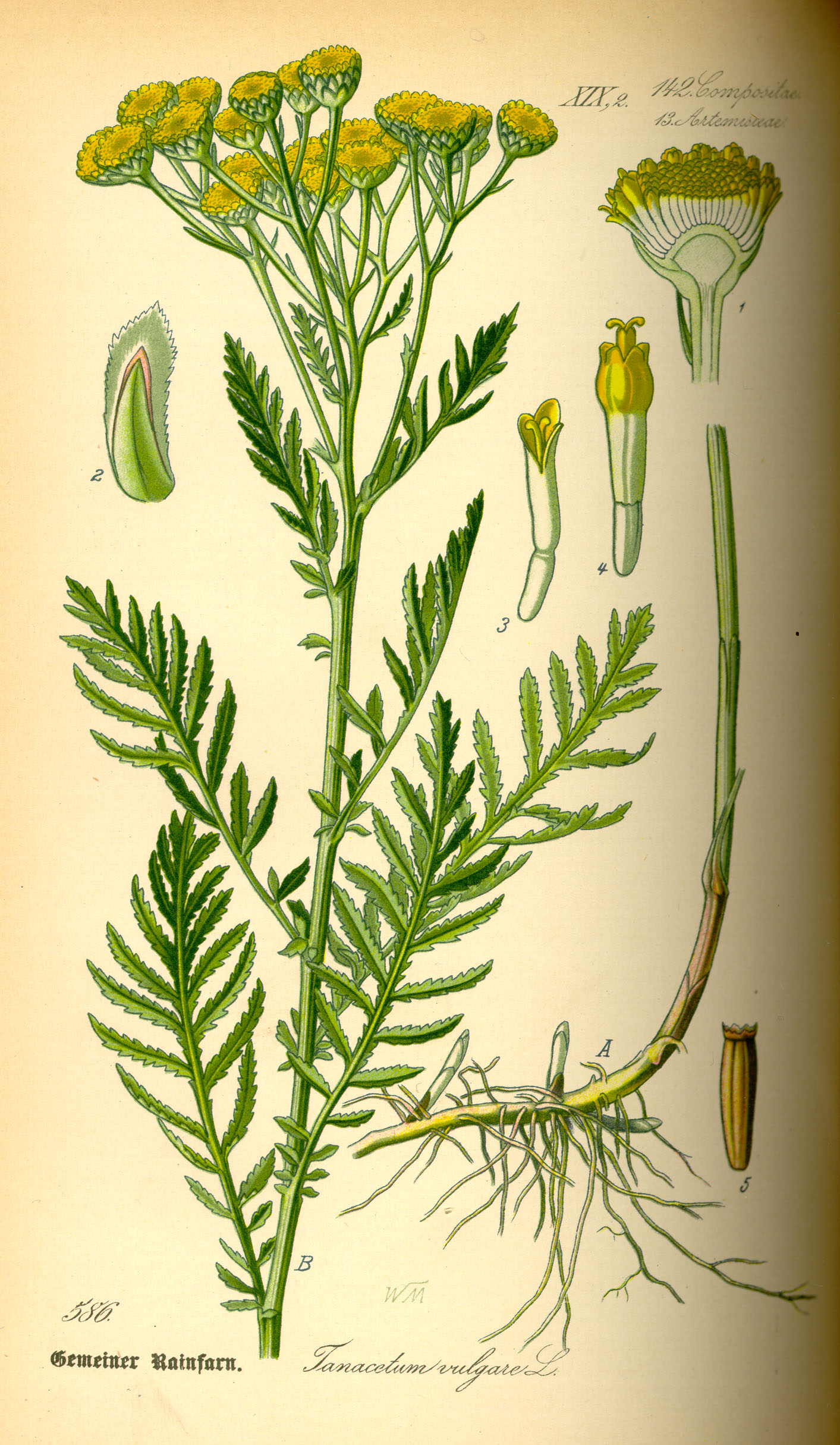
Can tansy planted under a tree negatively affect it?
What is the best way to plant Texas Mountain Laurel seed pods and how long do they take to germinate?
Should a lawn be scalped in the spring?
Scalping the lawn in early spring, bagging the clippings and leaves and placing them on the curb to be hauled off and buried in a landfill is a waste of time and money and is poor horticulture.
Everything that results from scalping is negative. Scalping and removing leaves exposes bare soil to direct sunlight, which burns out the humus and microbes on the soil surface. Because the sunlight can hit the soil, it also triggers the germination of weed seed. Scalping also removes valuable organic matter, which is the best natural fertilizer, and the procedure is hard on you and the lawn equipment.
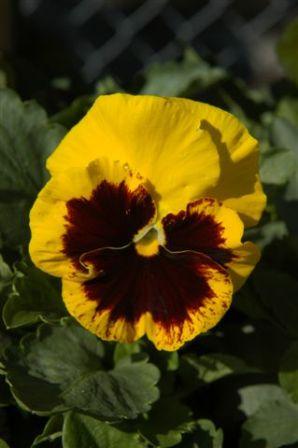
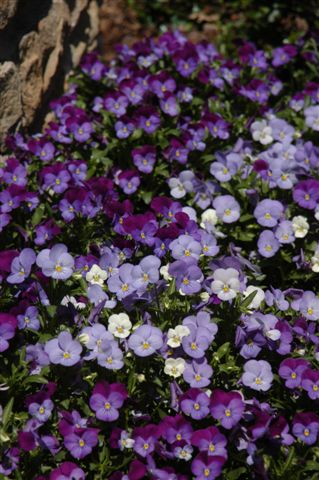
Does it help to fertilize pansies during winter?


What is the application rate for dry molasses on a lawn?
Molasses
Sweet syrup that is a carbohydrate used as a soil amendment to feed and stimulate microorganisms. Contains sulfur, potash, and many trace minerals. Approximate analysis is 1-0-5. Molasses provides food for microorganisms and is a source of carbon, sulfur, and potash. It is a good, quick source of energy for the soil life and microbes in a compost pile, and will chase fire ants away. It is a carbon source and feeds beneficial microbes creating greater nature fertility. Liquid molasses is used in sprays and dry molasses is used as an ingredient in organic fertilizers. It contains sulfur, potash, and other trace minerals. Excellent foliar feeding material and can be mixed with other organic liquids. Use at 2-4 quarts/acre for soil application. For foliar application on broadleaf plants use 1 pint per acre. For grasses and grains still use 1 quart per acre. Blackstrap molasses is the best choice because it contains the sulfur and iron of the original material.
Dry molasses isn’t really straight dried molasses. It’s molasses sprayed on a grain residue carrier. It’s an excellent carbon source that stimulates beneficial microorganisms. And, it repels fire ants.
Molasses is the best sugar for horticultural use because of its trace minerals. Blackstrap is hard to find but is the best molasses because of the sulfur and iron, but any kind will work. Molasses is a carbon source and feeds the beneficial microbes creating greater natural plant fertility. Molasses also has a nice side benefit. When used with compost tea and orange oil, it kills fire ants and other insect pests. By itself, molasses repels fire ants effectively.
Is the sap causing the worm issue, or are the worms causing the sap?
G.W., Fort Worth . Answer: The smell could indicate disease. The worms may or may not be part of the problem. Remove any soil covering the base of the tree and follow my Sick Tree Treatment . If the foam is coming from smooth-sided holes, borer insects are working on the tree and should be treated. Inject full-strength orange oil or d-limonene into the holes and seal the holes with my Tree Trunk Goop mixture (one-third compost, one-third soft rock phosphate and one-third natural diatomaceous earth; mix with water to make a paste). Stop using synthetic fertilizers..
Pest Control
What can I do to rid our house of the pests?
For more information see the Texas Bug Book.
|
Female black widow from the upper rear, showing pattern. |
Female black widow |
Dorsal view. Note that the red dot is formed by this spider’s spinnerets. |
|
Can you tell me whether or how to use Frontline for flea control in dogs?
Tip from listener V. Ross:
We have always used Brewers Yeast to keep fleas off the cat(s) we have owned. The Brewers Yeast repels the fleas but does not kill them. You can get pills that they can just crunch up like a snack & they seem to enjoy it. You can put some in with their food and they seem to self-regulate & stop when they have enough. Not sure about dogs but one or two pills a day would probably work for a dog. We lived near a forested area that our cat went into to hunt and never saw a flea except riding on the ends of his fur, nowhere near his skin. I believe it repels ticks too. No science, just our experience.
Tip from listener M. Dwyer:
I also use brewers yeast, when I remember. I bought a pound the last time, powder, I think intended for horses. Sprinkle a teaspoon or so over dry food, they love it. Vitamin B is supposedly the active part of it.
Is the harlequin bug a pest or a seasonal indicator?
”. Their eggs provide another fascinating feature. There are always ten eggs in a bunch, two rows of five side by side, and they look just like little wine barrels or kegs. You can see the “hoops,” the “cork” in the center, and the “staves” casting a shadow across the top. It is worth growing at least one mustard plant in the late spring just to get a look at the eggs..
Could there be another culprit?
C.S., Dallas. Answer: You are correct. The destruction of the natural life in the garden is just one, but one of the important negative aspects of the pyrethrum misting systems. I have no suggestion on how to neutralize the toxic chemical other than get the system shut down. I don’t accept pyrethrum as a safe organic product at all, and I have personally tried all the true organic ingredient substitutions. The end result is that I removed my system.. Most of the systems use synthetic pyrethroids or natural pyrethrum (pyrethrins). Both are toxic and I strongly oppose the use of both. These products are toxic to birds, frogs, lizards, cats, dogs and you. Yes, pyrethrum is natural – so are arsenic, hemlock and ricin.. Garlic, (dry and liquid) as explained in a past newsletter (see archives), works better and is non-toxic. If people are still trying to push these unacceptable products on you, here’s some new research and information that might help you make the right choice.. Pesticide-Induced Diseases Database. The common diseases affecting the public’s health are too well-known in the 21st century: asthma, autism and learning disabilities, birth defects and reproductive dysfunction, diabetes, Parkinson’s and Alzheimer’s diseases, and several types of cancer. Their connection to pesticide exposure continues to strengthen despite efforts to restrict individual chemical exposure, or mitigate chemical risks, using risk assessment-based policy.. The Pesticide-Induced Diseases Database, launched by Beyond Pesticides, facilitates access to epidemiologic and laboratory studies based on real world exposure scenarios that link public health effects to pesticides. The scientific literature documents elevated rates of chronic diseases among people exposed to pesticides, with increasing numbers of studies associated with both specific illnesses and a range of illnesses..
What pest causes damage to citrus tree leaves?
Do you know what this could be and how I can stop the sap?
My neighbor is willing to work with me on this. A.R., Dallas.
A: The dripping is the waste or “honeydew” of small insects called aphids or plant lice. They can be temporarily eliminated with strong sprays of anything, including water. Compost tea with orange oil or other plant oil products added to the water works better of course. The strong spray rips the pests off leaving their mouth parts still stuck in the plant tissue killing most of them. But, they will come right back unless the stress in the trees that brought them on in the first place is removed. Stress in the plant can be caused by too much or too little water, too much or the wrong kind of fertilizer, soil compaction, and soil contamination caused by herbicides and other toxic chemicals. One of the most common causes of stress in trees is deep planting. Make sure the tree is not too deep. The root flare should be exposed and visible above the ground. You can remove the soil yourself if the work is done very carefully, it’s best to hire an arborist to remove the soil with the device called the Air Spade.
What can I do about chiggers?
Q: I saw your suggestions about repelling chiggers and want to share with you how I handle them. Tea tree oil works well as a repellent, but I don’t like the fragrance, so I tried lemon-scented tea tree oil (the plant’s scientific name is Leptospermum petersonii. This is the main ingredient in SkeeterBeater, a blend of essential oils. I don’t use the spray and get insect bites, I dab them with a plant-oil product called Helichrysum italicum, also bought from Nature’s Gift. After a few minutes, the itching goes away. If the itching starts again after a few hours, I dab the bites again. A.H., La Crescenta, Calif.
A: Thanks for the tip. Although I haven’t tried this, it sounds reasonable.
Why do squirrels raid vegetable gardens instead of foraging in the wild?
Their gestation period is usually only about five or six weeks). This adds an extra urgency to their feeding habits. What to us sometimes seems like greed and gluttony may actually be “labors of love” for squirrels. But why aren’t they laboring in the wild instead of in our gourmet vegetable patches? The consensus is that it probably has more to do with our clear-cutting their arboreal homes than with squirrels developing a taste for haute cuisine.
If that doesn’t win you over to their side, keep in mind that squirrels are gardeners, too! Sort of. “Because they bury nuts and then often forget where they put them, squirrels are very effective agents of reforestation,” says University of Richmond biologist and squirrel expert Dr. Peter Smallwood. “But they provide other valuable ecosystem services, too. For instance, they make a tasty meal for predators like foxes, raccoons, and red-tailed hawks.”
Listener tip from Judy J: A tip for keeping squirrels from digging in your garden or planters – I grate some Irish Spring original bar soap and mix it with my warm used coffee grounds. I don’t have any problems so far and have many gray squirrels.
Is there a way to avoid having to do root flare exposure?
By the way – those same misguided folks will also recommend staking and thinning out newly planted trees. Two more bad ideas.
Disease Control
What can I do to kill the fungus without harming the jasmine?
I have a landscaped area in the back of my office that is covered mostly with asian jasmine and there is a cedar fence directly abutting the area where the jasmine grows. The area stays fairly moist and I have been noticing some wet spots on the bottom of the fence where the water obviously stays. There is some fungal growth creeping up the fence (4-5 inches). What can I do to kill the fungus without harming the jasmine? I water only when necessary to keep the moisture down. Any suggestions?? C.S., Dallas.
Could you tell me what is happening to our tree and what I should do to stop it?
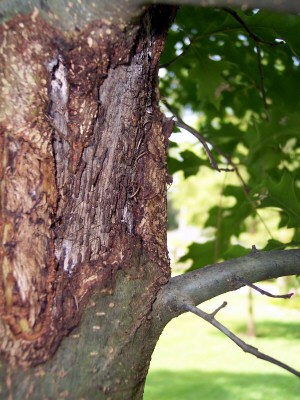
Thank you. S.F. Mineola. A: Animal damage like this cause severe injury to trees or shrubs. If the damage is all the way around the trunk, the tree will not survive. To prevent this problem in the future, increase the health of the soil and the tree. This tree is at least 6″ too deep in the ground. Its root flare should be exposed and any circling and girdling roots should be removed.. See this link for detailed information. Red oak fungal disease in California.. http://apsnet.org/pd/pdfs/2002/0115-01R.pdf.
Products & Recipes
In one of your books you say a Chinaberry tree will live for a few years, just how long is a few years?
Could you please tell me what else and of what measures goes into your health 'cocktail' recipe?
Thank you for you time. C.H., Dallas
A: Don’t have a firm recipe. Usually I use a heaping teaspoon of the diatomaceous earth, 1-2 tablespoons of organic apple cider vinegar, tablespoon of fish oil and fill the rest of the glass with juice (varies) and water.
Natural diatomaceous earth does several helpful things inside the bodies of animals. First, it is a natural internal parasite control, it also provides a long list of trace minerals and it helps pull toxins out of the body. It also helps with the complete digestion of food. The only DE products I recommend for this internal use and DiaSource.
Please check with you Doctor before trying anything.
Any other words of wisdom?
D.P., Dallas . ANSWER: That’s a tough one! I do not have any personal experience with that problem, but the nematodes would certainly be worth trying. Those reporting to me about controlling wild hogs have had to resort to trapping and shooting. I do know that this is one situation where using dry molasses is a bad idea. The hogs apparently have a sweet tooth..
Is roller-chopping an effective way to clear and control mesquite?
A: It’s a great way to control cedar but an ineffective way to control mesquite. Cedar won’t grow back and the shredded mulch left on the ground is an excellent soil builder. Mesquite will grow back. Best management for mesquite is to leave the big trees alone. Not only are they not a problem, they are beneficial to the soil. On acreage, livestock like the trees. The light shade is comfortable and the animals like the quality of the grass under mesquite trees. On the other hand, mesquites that have been sprayed, chained, or otherwise assaulted will grow back as bushes and NOW you have a problem. The only solution at this point is aggressive grubbing and ripping to remove the the plants. Those who recommend harsh herbicides are environmental polluters and ineffective to boot. Using diesel with molasses is OK to use for difficult to control trees..
Can I remove calcium from the water or neutralize it?
ANSWER: You need to balance the pH. Baking soda can be used to raise the pH, and vinegar will lower it. Litmus paper for testing the water can be purchased at pool-supply stores.
Is there anything that can be used in a pump sprayer to neutralize any pesticide or herbicide that may have been used in the sprayer?
Why should I be concerned about the use of Scourge?
What are the human health effects of Resmethrin?
Are the so-called "inert ingredients" of Scourge hazardous?
Aside from the dangers of Resmethrin and the inerts, there are no data on the cancer-causing effects of Scourge itself. This does not mean it is not cancer-causing, only that research has not been conducted. There is reason for concern, however, because chemical hazards often have additive effects. Recent studies published in the reputable and peer-reviewed journal Science have shown that some pesticides, when used together, have 1000 times the adverse human health effects of either alone. Scourge has not been examined for these types of “synergistic” effects.
Are children more vulnerable to Scourge pesticide exposure?
Are there safe alternatives to Scourge for controlling mosquito populations?
The first approach is based on public education and personal protection. It includes remaining indoors at dawn and dusk, installing and maintaining window and porch screens, wearing protective clothing, and minimal application of mosquito repellents to the exterior of clothing (not skin).
The second approach involves eliminating mosquito larvae in stagnant waters where they breed. By eliminating breeding areas with open marsh management procedures that are sensitive to wetland integrity, mosquito populations can be reduced. The most effective and long-term method for marsh water management is drainage of stagnant standing water in culverts, ditches, on public grounds and in residential areas.
Non-toxic larvicides are more effective than toxic adulticides for mosquito control. Selective application of small amounts of larvicides can achieve a great reduction in mosquito populations in contrast with the large amounts of adulticides needed to penetrate massive air space. Larvicides include: the application of larvicide oil which in thin films block larval breathing tubes; predators or parasites which under controlled ecological conditions can be used to keep larva populations down, and some natural insect toxins which can be applied to poison larvae without harming the surrounding ecosystem.
As the New York Department of Public Health emphasized in 1989: “Unless specific public health threats exist — the benefits (of adulticide spraying) are outweighed by its potential adverse effects on health and the environment.
The information above is adapted from the testimony of Dr. Samuel Epstein at the Open Forum of the North Shore Mosquito Abatement District, Cook County, Illinois on September 30, 1996.
Q & A from
Samuel S. Epstein, M.D.
Chairman, Cancer Prevention Coalition
Organic Methods
How do you diagnose and treat a declining tree?
Also, when do I trim back (the lower branches) of a Japanese black pine?
H.T.C., Dallas.. A: Many of the local nurseries have, or will soon have, bare root roses for sale. However, most would agree that planting container roses is a much better way to go. You will also have more success and less frustration by planting antique and other easy to maintain roses. They are available now and should planted as soon as possible. Print off a copy of the entire Organic Rose Program below:. Organic Rose Program 2011. Roses are actually easy to grow and should only be grown organically since they are one of the best medicinal and culinary herbs in the world. When they are loaded with toxic pesticides and other chemicals, this use is gone, or at least, it should be. Drinking rose hip tea or using rose petals in teas or salads sprayed with synthetic poisons is a really bad idea. For best results with roses of any kind, here’s the organic program that really works.. SELECTION. Buy and plant well-adapted roses for your area. Old roses will have the largest and most vitamin C filled hips. They are also the most fragrant and the best looking bushes for landscape use. However, any roses can be grown with this program.. PLANTING. Prepare rose beds by mixing the following into existing soil to form a raised bed: 6″ compost, ½” lava sand, ½” of decomposed granite, 20 lbs. of dry molasses, 20 lbs. of whole ground cornmeal, 30 lbs. zeolite and 20 lbs. of sul-po-mag per 1,000 sq. ft. Remove all the soil from the root balls and soak the bare roots in water with Garrett Juice and one of the mycorrhizal fungi products such as THRIVE per label directions. Spread roots out radiating from the trunk and settle the soil around plants with water. For root stimulation, Garrett Juice and THRIVE can be added to the soaking water or added when watering in the plants. Use the products at the same mixing rates used for spraying.. MULCHING. After installing the plants, cover all the soil in the beds with ½ – 1 inch of compost or earthworm castings followed by 2 – 3″ of shredded native tree trimmings mulch. Do not pile the mulch up on the stems of the roses.. WATERING. If possible, save and use rainwater for irrigation. If not, add one tablespoon of apple cider vinegar per gallon of water or Garrett Juice at half spray mix rate.. FEEDING SCHEDULE. Round #1: organic fertilizer or dry molasses @ 20 lbs. / 1,000 sq. ft., zeolite @ 40 lbs. / 1,000 sq. ft. and whole ground cornmeal at 10 – 20 lbs. / 1,000 sq. ft.. Round #2: organic fertilizer @ 20 lbs. / 1,000 sq. ft., greensand @ 40 lbs. / 1,000 sq. ft., soft rock phosphate or Flora Stim at 30 lbs. / 1,000 sq. ft.. Round #3: organic fertilizer such as alfalfa meal @ 20 lbs. / 1,000 sq. ft., and sul-po-mag @ 20 lbs. / 1,000 sq. ft.. PEST CONTROL. Apply dry granulated garlic to the soil.. For insect pest and disease control in general, spray roses every 30 days with Garrett Juice and garlic tea or Bio Wash.. For thrips, apply beneficial nematodes to the soil in early spring or when foliage begins to grow.. For more information, read Texas Gardening – The Natural Way..
Is there a problem with begonias this year?
A: It may be the growth retardants used at the wholesale growers. If additional fertilizer doesn’t help, that might be the case. Buying from garden centers that specialize in organic products and techniques will give you a better chance of getting vigorous plants.
NOTE: All begonia flowers are edible and useful in salads, teas and as garnish. One of the cane-stemmed angel wing begonias shown below.
Does the organic program improve the taste of food?
There are many reasons to go organic rather than use the synthetic, high nitrogen fertilizers and toxic chemical pesticides – especially when growing food crops and herbs, but for landscaping as well. Among the most obvious is avoidance of toxic stuff. Unhealthy chemicals that may lead to serious problems are not part of the organic program. The natural organic approach avoids hormones, antibiotics, drugs and other toxic chemistry that comes from products such as Roundup, 2,4-D, GMOs, Manage, Chlopyrifos, etc.. The organic approach also helps the environment by using products that don’t wash away after rains and don’t leach easily through the soil to contaminate the ground water. The toxic chemistry products do wash and leach.. Another reason is that organic gardening and landscaping is just more enjoyable. One of the most common reports from gardeners is that the enjoyment of working in the yard and garden is greatly increased. It’s just more fun to realize that you working within Nature’s laws and systems rather than trying to control and override the natural processes.. Fewer pest problems – definitely a benefit. My lectures on natural pest control always start by explaining the most import step in successful pest control – stopping the use of the destructive products and procedures. The high salt synthetic fertilizers and toxic pest control products do more harm than good. When the soil is healthy and the beneficial insects and microbes are protected, the number of insect and disease problems drop sharply. Having to treat less often for pests saves time and money.. Water bills drop from 40-50% when the organic program is used. How? Healthy, biologically active soil and plants with lots of mycorrhizal fungus on the roots simply hold water at the right level for a longer period of time.. Vegetables And finally – taste is better on food crops. Taste is harder to prove but here’s a story that explains it well. Several years ago a research project on a pecan orchard in Hamilton, Texas was done to study what worked better on pecan production – organic or conventional, and which organic program, if any, worked best. Dr. Joe Bradford of the USDA/ARC came up with the idea and was in charge of the project. Different organic approaches were used on certain trees and the university recommended control on others. Everyone involved was surprised that the organic pecan production was considerably heavier and everyone was also surprised that the flavor of the organic pecans was superior.. I – on the other hand – was not surprised. Healthy soil makes trace minerals more bio-available to plants, trace minerals help create complex carbohydrates (sugars) and that’s where the improved taste comes from – as well as fewer pest problems..
What are these little pests, and how can we get rid of them in a safe manner?
T.G., Dallas. Answer: What you probably have are fungus gnats. They are usually around when you have overripe fruit or you’re watering indoor plants too often. . If food is the problem, retire it to the compost pile. . If it’s plants, apply a thin layer of horticultural cornmeal to the soil and wait longer between waterings. The cornmeal will control the fungus growing in the potting soil, and the plants will enjoy the reduced watering schedule. . If a heavy population of gnats exists in the potted plants, drench the soil with a neem product, but not one that contains pyrethrum and piperonyl butoxide (PBO). More about these two substances below.. Commentary: It’s time I make myself very clear on the subject of pyrethrum and PBO. Pyrethrum is a natural material made from the painted daisy (Chrysanthemum cinerariaefolium or Chrysanthemum coccineum). Pyrethrins are the six compounds in pyrethrum that have insecticidal power. . I’ve been concerned about the misuse of pyrethrum products for some time, and I have never recommended a pyrethrum product that contains other toxic materials. One of the common extra ingredients is PBO, which is a synthetic synergist that gives the basic insecticide more killing power. . As you can read in the Journal of Pesticide Reform, (Vol. 22, No. 1), published by the Northwest Coalition for Alternatives to Pesticides, there are scary facets to pyrethrum. The journal says that, in laboratory tests, insecticides made from pyrethrum have caused tumors in animals, increased the risk of leukemia, disrupted the normal function of sex hormones, and triggered allergic reactions including heart attack and asthma (see . www.pesticide.org/Pyrethrins%Pyrethrum.pdf). . Because of a recent surge of interest in using pyrethrum for mosquito control, I feel that I need to make my warnings stronger. Pyrethrum and related products are neurotoxins. These days, they are being recommended for use as safe, natural insecticides. The concept of the backyard mosquito mist system in which they are being used is good, but cedar or other biological products should be used instead of neurotoxins. The alternatives work as well, but they don’t kill beneficial insects and are considerably less toxic. . In addition, some consultants and quite a few stores and contractors are selling and using combination pyrethrum/diatomaceous earth/PBO products. This concerns me because they are promoting these products as organics, and the idea often is marketed as something that I approve. I don’t approve. In my opinion, these pest-control products are in the same unacceptable category as diazinon, dursban, Sevin and Orthene. . PBO deserves specific comment as well. It shows up in a variety of pesticides, even some orange oil/d-limonene and neem products. These combinations are unacceptable in an organic program. You’ll find information about PBO in the Journal of Pesticide Reform, too. . PBO has some of the same toxicity issues as pyrethrum, but it is exponentially worse when mixed with other toxic chemicals to make them more effective at killing bugs. Pyrethrum products are toxic to bees, fish and other aquatic life, but they are even more toxic when PBO is added. For me, pyrethrum no longer is an acceptable insect control in an organic program. Pyrethrum combined with PBO has never been acceptable. . Furthermore, synthetic pyrethroids that also contain PBO are even worse than the “natural” products. Synthetic pyrethroids are similar in chemistry and action to pyrethrum pesticides, but they are a bigger problem for people with allergies and asthma. One of those synthetic pyrethroid products is Scourge, which is being used by Dallas and other cities for mosquito control. Its active ingredients are a pyrethroid called resmethrin and PBO. Some consumer products containing synthetic pyrethroids also are available for the control of ticks, fleas, ants and other insects. I urge you to avoid them..
Can I apply corn gluten meal later than March 1st?
— D.B., Dallas.. Answer: Yes, it functions as a powerful fertilizer any month of the year.. Question: When listening to your radio show, I have heard you talk of using corn gluten as a fertilizer.
Could you tell me what the fertilizer analysis would be on pelletized corn gluten?
I have heard you talk of using corn gluten as a fertilizer. Could you tell me what the fertilizer analysis would be on pelletized corn gluten? I was considering this as a fertilizer on rye grass and wheat for cattle pasture and wondered if it would be feasible. — J.D., Dallas
Answer: The analysis of corn gluten meal ranges from 9-0-0 to 10-0-0. It would work well for pasture feeding but would be costly. Dry molasses might be better. The n-p-k is not as important as building soil life, which the dry molasses does effectively and at a reasonable cost. Apply it at 200 – 400 lbs. per acre.
How do you treat the black powdery substance on crape myrtles?
The Sick Tree Treatment is on the site here but here’s the shorthand form:
1. Expose the flare by removing plants, mulches and soil.
2. Aerate the soil or apply hydrogen peroxide mixed with water 50/50.
3. Broadcast cornmeal, Azomite, lava sand, dry molasses and compost.
4. Add cedar – cedar flakes in turf areas and shredded cedar in beds or bare areas.
Do you need to remove all weed roots before adding compost and amendments?
How do you control crawfish in the yard without chemicals?
What is the best way to help a struggling plant recover?
Thanks very much. J.C., Lewisville Jan 2010
A: Way too far north for them to be outside. Cut the dead fronds off, drench the soil with Garrett Juice or a homemade aerated compost tea and cover the plants with floating row cover if more cold weather comes this way. For long term success with sago palms, move to Houston.
What are the unusual growths (galls) in my trees?
This is a very common question I get. These growths are called galls and there are many different kinds. They are primarily caused by benign wasps, flies and other insects, but can also be caused by disease organisms. Most galls are more cosmetic than damaging. But here is more information on these interesting growths called
.
A few galls are no problem but a heavy infestation is a definite sign that your tree is in stress. To be proactive and help your trees resist galls and more serious pests, use the Basic Organic Program and spray every few weeks with Garrett Juice. Exposing the flares of trees will prevent serious infestations and also work as a curative. It is the first step of the Sick Tree Treatment.
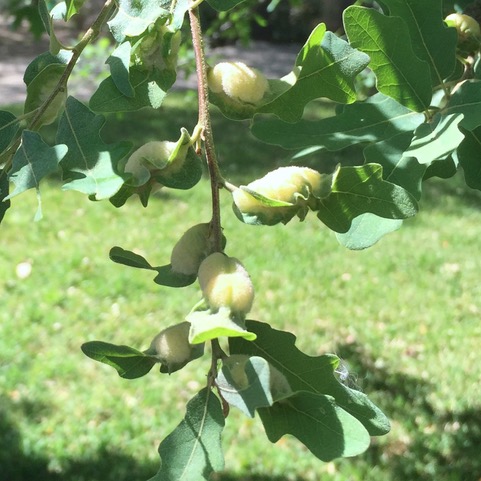 |
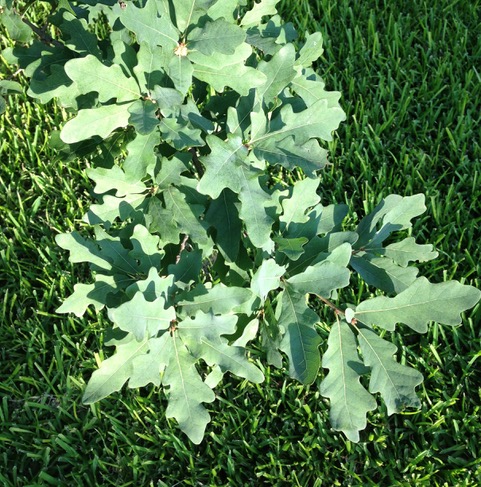 |
| Galls before applying Sick Tree Treatment. | Clean foliage after applying Sick Tree Treatment. |
Is it something we should try to get, or do more readily available products fill the bill?
M.M., Athens. Answer: Because glacier rock dust is loaded with trace minerals, it’s probably beneficial for the soil. The only question is the cost vs. that of lava sand, granite, green sand, etc. I know of no other sources. Howard Garrett Organic Gardening Gardening the Natural Way.
What causes leaf drop in trees after heavy storms?
D.C., Dallas. ANSWER. : Many red oaks lost leaves early last fall. Heavy rains in the spring followed by intense heat and humidity caused it. Spraying the foliage next year with compost tea or Garrett Juice should help reduce leaf drop.. . Animal damage . QUESTION: We planted a 5-gallon Shumard red oak about four years ago. It has grown very well without any problems. Recently, I noticed that the bark has been chipped away nearly all the way around the bottom of the tree. Upon inspection, I see that there are several joints where the bark is gone.
What organic methods discourage animal pests from damaging the yard?
What are beneficial nematodes, and how should I use them?
The best technique is to apply nematodes before heavy pest infestations are expected, and to follow up with additional monthly applications. The period between the year’s last spring freeze and first fall freeze is the best time to apply nematodes.
Broadcast applications are best, but spot treating can be an economical option. One treatment per year usually is enough.
Beneficial nematodes kill thrips that are about to attack roses, young ticks, fleas, grub worms, termites, fire ants, roaches and other pests that have at least one life cycle in the soil. They do not harm beneficial insects.
FOR OTHER INSECTS CHECK THE TEXAS BUG BOOK APPROPRIATE FOR HOME AND GARDENERS AND COMMERCIAL GROWERS COAST TO COAST AND BORDER TO BORDER.
Are tree galls a pest problem or just a curiosity?
There are many different kinds of galls. They are primarily caused by wasps, flies, aphids and other small insects and are usually more cosmetic than damaging. On the other hand, when trees are heavily infested with galls, there’s a problem – but there’s a solution.. . Galls before applying Sick Tree Treatment.. Tiny insects such as female gall wasps or cynipid wasps pierce twigs or leaves with egg laying egg laying devices and deposit eggs inside the plant tissue. Fluids deposited with the egg and produced by the larva cause the plant cell multiplication process to begin. This distorted growth results in various forms. Some galls are hard and light and airy, some are fuzzy, some look like aliens, some look like bad acne and some look like bloodshot eyeballs. The larvae develop inside the gall, feeding on material produced in the cavity lining. At maturity, the larvae transform into a pupa, and later become adults that chew out of the gall. By causing trees to form galls, the gall wasp has provided food and shelter for its offspring. Although unsightly, most galls are not considered very damaging.. There is a curiosity about this.
Why do gall-forming insects choose some trees over others?
Some trees get heavy infestations and some trees of the same species have no galls to be found. Could it be that healthy trees have a natural resistance to the insects that create the galls? I think so. I’m gathering more and more proof that when trees are in stress, the distribution and concentration of sugars in the trees has a definite influence on whether diseases, insects, woodpeckers or rodents attack and do damage. Yes, and galls.
Could it be that healthy trees have a natural resistance to the insects that create the galls?
I think so. I’m gathering more and more proof that when trees are in stress, the distribution and concentration of sugars in the trees has a definite influence on whether diseases, insects, woodpeckers or rodents attack and do damage. Yes, and galls.
Galls after applying the Sick Tree Treatment.
In the past I recommended spraying every few weeks with the Garrett Juice mixture and an organic pest control such as BioSafe, but that might not be necessary. I discovered something very interesting on one of my own trees. A Lacey oak in our experimental gardens looked relatively healthy and was growing at a decent rate each year, but starting in 2015 it began to have some fuzzy oak galls that deformed
the leaves. I shrugged it off at first as I often suggest to others. But, the next year the population of galls was heavier and got my attention. Long story short, I applied the Sick Tree Treatment. The first step was to dramatically expose the root flare and the girdling roots that were exposed. The second photo shown here was taken summer of 2017. Galls are completely gone.
The secret is soil health, stress free trees and use of the
.
Should the wire and burlap on the ball of the tree be removed?
D.C., Dallas. Answer: The burlap should be removed. There will usually be some excess soil under the burlap on top of the root ball. That soil also should be removed. The only root stimulator I recommend is my recipe for Garrett Juice (see Resources to request handouts). . I don’t recommend water rings. If trees are planted using natural techniques, if the planting hole is backfilled with soil that was dug out to create the hole, and if the tree is watered thoroughly at planting time, additional water other than that used on surrounding plants is rarely needed. Deep watering twice a week is almost always too much. Many more trees die from too much rather than too little water..
Since I missed the best fall planting window, when would be the best time to plant?
Or should I treat the area for a year and plant next year?
— S.K., Fort Worth. ANSWER: Remove the railroad ties, and then decontaminate the site. First, apply activated charcoal at a rate of 100 pounds per 1,000 square feet. Follow that with zeolite at 80 pounds per 1,000 square feet, and then apply Garrett Juice at about 2 gallons per 1,000 square feet. After that, follow my Basic Organic Program, but double the rate of dry molasses.. Railroad ties are wood timbers used to support steel rails, and are treated with heavy duty preservatives to prolong their life. According to the Creosote Council, “approximately 95% of all new railroad ties are preserved wood, as opposed to non-wood products of concrete, steel, or plastic. Of the wooden ties purchased, 98% are either creosote or creosote-borate treated. Approximately 2% of wooden ties are copper naphthenate or copper naphthenate-borate treated.” Good for railroads, not good for gardens. . Railroad ties removed from service are still full of chemical preservatives Railroad ties can contaminate the soil of the garden
What is the green and black growth on bare muddy ground after heavy rain?
A: It could be mold but is probably algae. It can easily be killed with the hydrogen peroxide spray. Dilute the 3% grocery store product with water in a 50-50 mix and spray the problem areas.
How do you fix water pooling against a house foundation?
Why are my peach tree leaves drooping and peaches shriveling after heavy rain?
What is eating all the leaves off my roses this wet spring?
What is killing my coneflowers, coreopsis, and other plants?
As a final comment – please turn the sprinklers off. You’re wasting water and money as well as pouring gasoline on the fire! The enormous rain is doing enough damage without your help. I realize that most of you organic gardeners leave your systems on manual and don’t make this serious mistake, but help me spread the word to those unenlightened ones.
Is water standing in the root flare depression a problem?
In most cases the water evaporates and drains away within a day or so. Remember that before the soil was removed, the flare was staying moist all the time. Having a dry flare that “breathes” properly is an important part of the recommended work and the reason it works so well.
If water stays too long and looks bad, a drainage ditch can be dug from the depression at the base of the tree to a lower point on the site and filled with coarse gravel all the way to the soil surface. I usually don’t do this but it works well when needed.
How far down and out the exposure should go is subjective. It depends on how deep the flare is buried. Even if you think the tree was planted correctly at the right height, most trees being sold today are too deep in the container when purchased – both containerized and balled and burlapped trees. You need strongly visible flares all around the tree with none or very little straight or flat bark tissue emerging from the ground. I have never seen a situation where the flare was exposed too much and led to problems.
Do you ever need to do root flare exposure more than once?
Again, subjective. When water floods a site and debris rebuilds on the base of the tree, the soil and other debris needs to be removed again. Once the tree and the flare grows enough, a redo is rarely needed.
What time of the year is best for the flare exposure work?
Fall and winter are probably ideal but I have seen hundreds of trees exposed in every month of the year without any ill effects. In fact, of all the many trees I’ve seen exposed, only two didn’t make it. One was a small fruit tree that had almost no roots at all and the other one was a large oak that because of a leaking irrigation system had pathogens and rot covering almost the entire root system. Both were too far gone, unfortunately. My best advice on when to do the work is – as soon as possible.
Are there tree varieties that don't need root flare exposure?
Yes – palm trees have a completely different vascular system and no flares. Some will try to argue that bottomland trees like pecans, green ash and sycamore are used to being deep in the ground and wet, thus don’t the exposure done. These trees are more tolerate of the moist conditions but even they respond beautifully to being exposed properly.
How quickly do results appear after root flare exposure?
In most cases, dramatic improvement in color and new growth is seen soon after the work is done. By the next growing season for sure.
Here’s a past newsletter that covers some additional details on this important, tree saving procedure.
Why is root flare exposure work needed on older trees?
People in this category are usually greatly surprised how well treated trees do compared to how they looked and grew before the work was done. Disappearance of mistletoe, sapsucker damage and other pests always grab their attention. Tree age has little to do with whether the work is needed. The national champion pecan tree in Weatherford has had more than 4 feet of soil removed from its base and this great tree is many hundreds of years old.
Some people scratch their heads about why certain trees can tolerate being too deep in the soil more than others. Bottomland trees such as green ash, pecan, sycamore and others can better tolerate the moist soil covering there flares – but, they will grow better and have fewer pests if uncovered and respond just like the more drought tolerant trees.
 Water standing around exposed trees is usually nothing to worry about, but drainage can be added if necessary |
Water standing in depressions created when uncovering root flares raises questions. You might not like the look of the depressions at the bases of trees, but water standing temporarily is not a big concern. Remember that before the work was done, moist soil was against the flare and trunk all the time. If water after a rain stays at the tree base for a long time because of heavy soil or poor grading on the site, drainage can be added. Dig a ditch from the depression out to a lower point on the site and fill the ditch full of crushed gravel all the way to the surface of the ground. Pipes and filter fabrics are not needed. Mulch can be used to cover the surface of the gravel-filled ditch but grass and other plantings will cover it fairly quickly.
 You should be able to stand on the flares of properly exposed trees – as here with the Arkansas state champion magnolia |
The timing question is simple. Do the work as soon as possible so the trees can get on their way to better health. Winter is the ideal time and spring is probably the most questionable time, but competent arborists are doing this work year round.
Where can I get bare root roses and when should I plant them?
Should I still prune roses in February if they are already leafing out?
EarthKind Roses
‘Caldwell Pink’– A compact found rose discovered in Caldwell, Texas. This is an ever-blooming variety with double lilac-pink flowers that form dense clusters. The plants have both attractive flowers and foliage. Ht x Wd: 4 x 4 ft.
‘Katy Road Pink’ – A found rose with pink semi-double fragrant blooms. The flowers are very large and impressive. Ht x Wd: 6 x 5 ft.
‘Belinda’s Dream’ – A compact shrub rose that was introduced in 1992. Produces lots of blooms that look like a classic cut-flower rose with a petal count 100+. Plants are tolerant of powdery mildew with some minor foliage drop in early spring to black spot. Ht. x Wd: 5 x 5 ft.
‘Sea Foam’ – A shrub rose that was introduced in 1964. This rose grows as a trailer or mannerly climber. The double blooms are ivory in color and fragrant. It is a vigorous grower. Ht x Wd: 3 x 6 ft.
‘Knock Out’ – A compact shrub rose with bright cherry red, semi-double blooms. This is a very striking rose in the landscape. Plants bloom continuously from spring until frost. ‘Knock Out’ also has beautiful glossy dark green foliage. Very disease tolerant. Ht x Wd: 4 x 4 ft.
‘Mutabilis’ – A large China rose that was introduced prior to 1894. The single open blooms darken with age from yellow to orange, pink and then crimson. The multi-colored effect is beautiful in the landscape. ‘Mutabilis’ has good foliage color and resistance to powdery mildew. Ht x Wd: 6 x 6 ft.
‘Marie Daly’ – A polyantha rose that is a sport of the older variety ‘Marie Pavie’, which was introduced in 1888. The small double blooms are produced in clusters and have a sweet scent. Low incidence of powdery mildew and black spot in early spring. Ht x Wd: 3 x 3 ft.
‘Perle D’ Or’ – A compact polyantha rose with peachy pink pompon blooms that are fragrant. The color is unique and plants are ever-blooming. Plants also have attractive glossy foliage. Ht. x Wd.: 4 x 4 ft.
‘The Fairy’ – A polyantha rose that was introduced in 1932. This rose is a good summer bloomer. Plants produce sprays of small, double pink blooms. Flowers tend to be a darker pink in cooler temperatures, and then fade to a pale pink in the heat of the summer. Ht x Wd: 3 x 3 ft.
‘Climbing Pinkie’ – A large, vigorous polyantha rose that was introduced in 1952. A nearly thornless climber that grows with or without support. Plants produce semi-double light-pink flowers with a long blooming period. Ht X Wd: 6-7 ft shrub, 8-12 ft climber.
‘Else Poulson’ – A floribunda rose with pink, semi-double blooms. Plants have a low incidence of powdery mildew in early spring. Ht x Wd: 5 x 5 ft.>
(Early publicity on the EarthKind roses also listed ‘Livin’ Easy’ and ‘Easy Going’, but these two varieties were subsequently removed from the EarthKind list.)
Is there anything I can do to loosen up the clay soil in my front lawn?
Use this thought model. Before choosing a product to use on your property, ask this: if I purchase and use this product, will it help or hurt the life in the soil? When the beneficial bacteria, fungi, protozoa, insects, earthworms and others are healthy, growing and reproducing, the soil’s chemistry, biology and structure will be soft, crumbly and productive.
|
Worst for Soil Health
|
|
Best for Soil Health
|
For more detailed information on soil building, check our new book – Organic Management for the Professional.
How do you extend the life of annual and perennial plants?
On our Tomato plants the leaves are turning yellow at the bottom. What could the problem be?
What does it mean when mushrooms grow on tree trunks?
Tree ears or shelf fungi are signs of disease and rot active in the tree. Some tree folks say that nothing can be done – that the tree is going to die. I do not agree with that.

Champion pecan after flare is dramatically exposed
It these growths have been present for several years and rot inside has been allowed to spread through a large percentage of the trunk, the tree might not make it. On the other hand, if a procedure I recommend is used soon after the growths appear, the tree can be saved and brought back to complete health and vigorous growth.
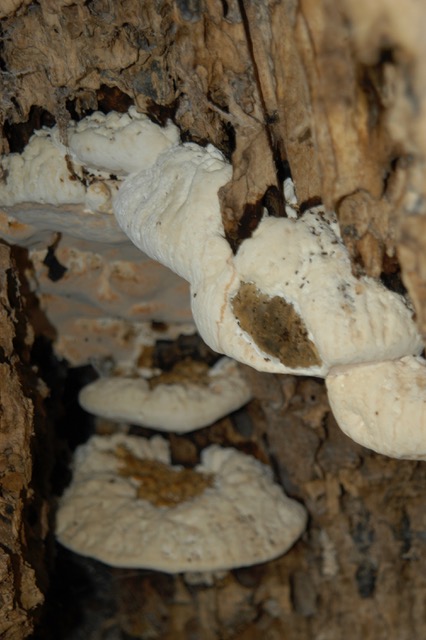
Tree ears
Also called bark fungus, bract fungus, bracket fungus and conks, these various colorful growths indicate that fungi rot is breaking down the lignin in the wood. The mushrooms are the fruiting bodies of brown rot, white rot and other similar fungal diseases.
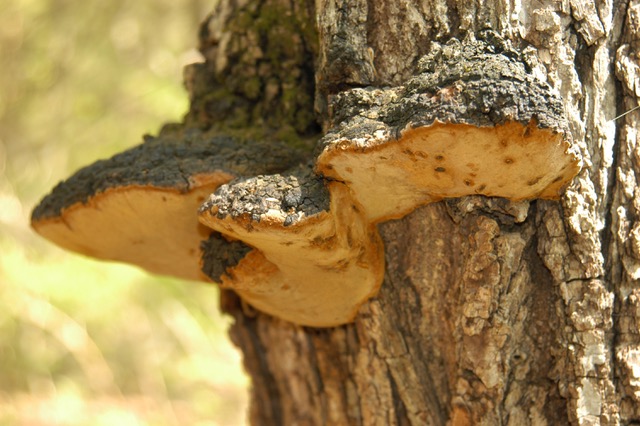
Tree ears are a form of shelf fungus
These fungi can show up any time of the year and attack many different species of trees. It is said that by the time a bracket appears there will be extensive heartwood decay – but that is not always the case. These growths live on and decay the heartwood. They do not infect and kill the living parts of the tree, however, associated symptoms may be dead limb tips, falling branches and thinning of the canopy.
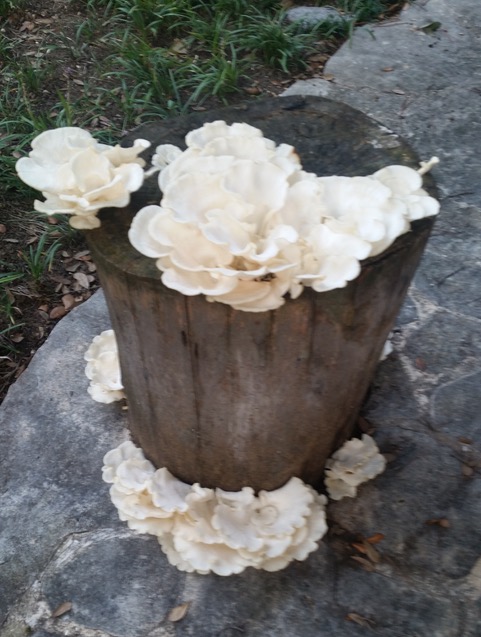
Tree ears growing dead log
Removing the surface brackets will have little effect on controlling the disease but the removal of the stress that caused the disease to strike in the first place is effective. By the way, these tree ears are beneficial when chopped up and used in the compost pile and pose no risk there at all.

Lichen is a different bark growth that does hurt the tree
Injecting toxic pesticides has little effect on these fungi short term and no beneficial effect in the long term. If anything is injected into these sick trees, it should be hydrogen peroxide. I have a chart of the mixing and application rates on dirtdoctor.com but properly labeled hydrogen peroxide and other organic disease control products are available from the BioSafe and Puregro companies.
The complete solution is to eliminate the stress in the tree with the application of the Sick Tree Treatment. The most important step of the STT is the dramatic exposure of the root flare. The rest of the procedure is to apply the same organic amendments used for bed prep – compost, rock minerals and cornmeal. When the bark of the flare can breathe properly and good microbes start to revive, the fix has begun. The results from this procedure can be impressive. This is the procedure that saved the champion pecan in Weatherford.
Is there a chemical I can spray to kill off the mushroom that will not harm the willow tree?
Growths like this are the fruiting bodies of fungi that has infested the truck of the tree. Spraying this growth with a toxic chemical fungicide or with one of the organic ones will kill the part you can see but will have no effect on the infection that is going on inside the trunk. Injecting the fungicides into the trunk will be more effective at killing the disease but unless something is done to correct the cause that invited the pathogen in the first place, it will grow right back, usually with a vengeance.. The next step is change the general health of the tree so the disease will not return anytime soon. The first step to to properly expose the trunk flare. Here’s the link to information on that procedure. . The rest of the Sick Tree Treatment is explained in this link. . Now I will have to say that willow trees are not long lived and the basic stress on the tree in this case may be just old age. However, this solution is worth a try because the tree appears to be worth the effort and even if it dies, the soil in the area will have been greatly improved for whatever else is planted..
What is the Texas Organic Research Center all about?
Last week two long-form articles were reprinted in the Dirt Doctor’s Texas Organic Research Center pages. They were significant in that both originating publications allow (and encourage) reprints in order to share (for credit) the information they report on. The newest posts appear on top of the TORC homepage. But whether reprinting or paraphrasing, the work of TORC is to keep a record of problems and research that affects all of us. What follows is some of our recent coverage, and in their own way represent the yin and yang of our database of news – the good and the bad juxtaposed so we learn about what is working and what isn’t. . The New Lede is a publication project from the Environmental Working Group, “a nonprofit, nonpartisan organization devoted to conducting and communicating scientific research that helps inform public policy on human and environmental health issues.” In November, they published Despite critics, organic farming thrives in heart of US corn country, an examination of a successful organic corn farm that started using organics in 1998.. What’s occurred here since 1998, when farmer Barry Fehr experimented with raising chemical-free soybeans on 45 acres, is the development of the most expansive and profitable area of organic grain production in Iowa, and possibly the United States. Most of the land is farmed by multiple generations of the Fehr family. The family also manages about 3,000 organic acres in Colorado. Generating millions of dollars annually in a “sustainable income,” the success of the organic operations here in the heart of corn country defies long-held conventions about a need for chemicals in farming.. Clear Creek Acres in Iowa is an example of a scaled-up large successful organic farming operation. (Photos credits to The New Lede) The yields on this farm are close to the levels of “conventionally grown” crops, coming in about 10% less, but their costs are lower because they aren’t spending on pesticides and expensive GMO seeds. As a result, they get more for their crop because of the demand for organic products.. The amount of land under production with organic methods has grown over the years. Farming without using the expensive GMO seeds and chemical fertilizers, insecticides, and herbicides is less expensive, so a slightly smaller yield is offset by the lower cost overall.. Another part of the production that keeps costs down is that the Fehr family farm is in a community of farms that own and share their equipment. Farm workers hired under a federal special agricultural visa program weed by hand (and earn about $30 an hour). The man-hours are more intense than non-organic farming, but there is still profit.. Working in this organic environment is healthier, but the region as a whole still has some issues because there are both organic and non-organic farms in the area. The environment aspects of these agricultural projects are being studied by the USDA in a multi-year program looking at the water quality in the Emmetsburg, Iowa, area to see which farms are contributing to the phosphorus pollution of waterways in the region.. Jack Fehr harvesting organic soybeans on Clear Creek Acres. . Find that TORC article here. . ________________________________________________. The Coleman farm has lost more than 35 animals due to polluted fertilizer. These calves died less than a week after birth. The Texas Tribune is a member-supported, digital-first, nonpartisan media organization that informs Texans about public policy, politics, government and statewide issues. In early December the Tribune published an investigative story that details the disastrous results of Biosolid contamination on ranches across the North Texas region. In the piece Texas farmers say sewage-based fertilizer tainted with “forever chemicals” poisoned their land and killed their livestock, farmers and ranchers were interviewed about the reason their animals are dying on their land.. An environmental crime investigator in Johnson County collected samples of the dead animals’ tissue and organs, the water they drank from, the soil and the fertilizer that was applied next door. After the county received test results, the two families finally got their answer: The animals had been killed by something in the fertilizer.. PFAS, or perfluoroalkyl and polyfluoroalkyl substances, are man-made chemicals used since the 1940s that have a singular ability to repel oil and water and resist heat. They are used in products like nonstick cookware, pizza boxes, waterproof mascara, toilet paper, soaps and rain jackets.. We all use these substances, and they end up in our bodies, our sewage, and in our food supply. Consumer products such as grease-resistant food wrappers, our drinking water, and in everything from dental floss to our phones and other electronics, paper products, and it household dust.. PFAS arrived on the property in the form of a contaminant in biosolid fertilizers produced from the solids that are treated and then dried to be sold as fertilizer for agricultural lands. In 2022 the Environmental Working Group estimated that up to 20 million acres of crop fields may have had these solids spread on them.. The Colemans run a “zombie farm” and will never sell these animals or this hay (Photos from Texas Tribune) The EPA has recently set standards for PFAS in public drinking water, but the current stage is monitoring, the regulations won’t go into effect for compliance until 2029. But those rules don’t cover biosolids. The levels of PFOS found in the tissue of one dead calf tested at 320ppt. “Samples of the pond water where the ranching families’ livestock drink from ranged from 84 ppt to 1,333 ppt of PFAS,” according to the article. States are beginning to test and regulate farms that are contaminated, but Texas isn’t one of them.. Johnson County farmers interviewed in the Tribune article have decided not to sell their cattle since their land is contaminated, and now run “zombie farms” – where they pay to feed animals and harvest hay they will never sell.. “These people were led to believe this was safe and a cheap fertilizer,” County Commissioner Larry Woolley said at the meeting. “And this isn’t just isolated to this one incident or multiple counties. This is going on all over.
Environment & Organic Living
Who regulates GMOs in the United States?
-
The USDA’s Animal and Plant Health Inspection Service (APHIS) regulates the field testing of genetically engineered plants and certain microorganisms.
-
The Department of Health and Human Service’s Food and Drug Administration (FDA) governs the safety and labeling of drugs and the nation’s food and feed supply, excluding meat and poultry.
-
The Environmental Protection Agency (EPA) ensures the safety and safe use of pesticidal and herbicidal substances in the environment and for certain industrial uses of microbes in the environment.
Some food manufacturers have announced that they won't accept GMO foods. Isn't that proof that GMOs are unsafe?
Different species of wildlife and farm animals are trying to tell us something by clearly preferring not to eat Genetically Engineered foods when they have a choice of naturally grown corn, soybeans and other crops as the following wisdom of nature anecdotes confirms. They are smarter than people when it comes to the right choices for eating.
Neil Carman, Ph.D.
Sierra Club Genetic Engineering Committee
http://www.SierraClub.org/biotech
Excerpts from the new book Seeds of Deception: Exposing Industry and Government Lies About the Safety of the Genetically Engineered
Foods You’re Eating
by Jeffrey M. Smith
http://www.SeedsofDeception.org
WISDOM OF THE GEESE – p. 45 excerpt
There’s a farmer in Illinois who’s been planting soybeans on his
50-acre field for years. Unfortunately, he also had a flock of
soybean-eating geese that took up residence in a pond nearby.
Geese, being creatures of habit, returned to the same spot the
next year to again feast on his soybeans. But this time, the geese ate
only from a specific part of this field. There, as a result of their
feasting, the beans grew only ankle high. The geese, it seemed, were
boycotting the other part of the same field where the beans were
able to grow waist-high. The reason: this year, the farmer had tried
the new, genetically engineered soybeans. And you can see exactly
where they were planted, for there is a line right down the middle
of his field with the natural beans on one side, and the genetically
engineered soybeans, untouched by the geese, on the other.
Visiting that Illinois farm, veteran agricultural writer C.F. Marley
said, “I’ve never seen anything like it. What’s amazing is that the
field with Roundup Ready [genetically engineered] beans had
been planted to conventional beans the previous year, and the
geese ate them. This year, they won’t go near that field.” 1
————————————————————————-
WISDOM OF THE COWS – p. 76 excerpt
In 1998, Howard Vlieger harvested both natural corn and a
genetically modified Bt variety on his farm in Maurice, Iowa.
Curious about how his cows would react to the pesticide-
producing Bt corn, he filled one side of his sixteen-foot trough
with the Bt and dumped natural corn on the other side. Normally,
his cows would eat as much corn as was available, never leaving
leftovers. But when he let twenty-five of them into the pen, they
all congregated on the side of the trough with the natural corn.
When it was gone, they nibbled a bit on the Bt, but quickly
changed their minds and walked away.
A couple of years later, Vlieger joined a room full of farmers in
Ames, Iowa to hear presidential candidate Al Gore. Troubled by
Gore’s unquestioning acceptance of GM foods, Vlieger asked Gore
to support a recently introduced bill in Congress requiring that GM
foods be labeled. Gore replied that scientists said there is no
difference between GM and non-GM foods. Vlieger said he
respectfully disagreed and described how his cows refused to eat
the GM corn. He added, “My cows are smarter than those scientists
were.” The room erupted in applause. Gore asked if any other farmers
noticed a difference in the way their animals responded to
GM food. About twelve to fifteen hands went up. 1
“If a field contained GM and non-GM maize, cattle would
always eat the non-GM first.” –Gale Lush, Nebraska
“A neighbor had been growing Pioneer Bt corn. When the cattle
were turned out onto the stalks they just wouldn’t eat them.” 2
–Gary Smith, Montana
“While my cows show a preference for open-pollinated corn over
the hybrid varieties, they both beat Bt-corn hands down.”
–Tim Eisenbeis, South Dakota
According to a 1999 Acres USA article, cattle even broke
through a fence and walked through a field of Roundup Ready
corn to get to a non-GM variety that they ate. The cows left the
GM corn untouched.
—————————————————————————————————————-
WISDOM OF THE COWS AND HOGS – p. 106 excerpt
Bill Lashmett watched as two or three cows were let into a
feeding area at a time. The first trough they came to contained fifty
pounds of shelled Bt corn. The cows sniffed it, withdrew, and
walked over to the next trough, which contained fifty pounds of
natural shelled corn. The cows finished it off. When they were
gone and released from the pen, the next group came in and did
the same thing. Lashmett said the same experiment was
conducted on about six or seven farms in Northwest Iowa, in
1998 and again in 1999. Identical trials with hogs yielded the
same results, also for two years in a row.
—————————————————————————————————————-
WISDOM OF SQUIRRELS, ELK, DEER, RACCOONS, AND MICE – p. 126 excerpt
For years, a retired Iowa farmer fed squirrels on his farm through
the winter months by placing corncobs on feeders. One year, just
for the heck of it, he decided to see if the squirrels had a preference
for Bt corn or natural corn. He put natural corn in one feeder
and Bt corn in another about twenty feet away. The squirrels ate
all the corn off the natural cobs but didn’t touch the Bt. The farmer
dutifully refilled the feeder with more natural corn and sure
enough, it was soon gone. The Bt, however, remained untouched.
The retired farmer got curious. What if the Bt variety was the
squirrels’ only choice? To find out, he didn’t refill the natural corn.
At the time, Iowa was plunged into the coldest days of the winter. But
day after day, the Bt cob remained intact. The squirrels went elsewhere
for their food. After about ten days, the squirrels ate about
an inch off the tip of an ear, but that’s all. The farmer felt sorry for
the squirrels and put natural corn back into the feeders, which the
squirrels once again consumed. 1
“A captive elk escape and took up residence in our crops of
organic corn and soy. It had total access to the neighboring
fields of GM crops, but never went into them.” 2
-Susan and Mark Fitzgerald, Minnesota
Writer Steve Sprinkel described a herd of about forty deer that
ate from the field of organic soybeans, but not the Roundup Ready
variety across the road. Likewise, raccoons devoured organic corn,
but didn’t touch an ear of Bt corn growing down the road. “Even the
mice will move on down the line if given an alternative to
these ‘crops.’ ” 3
A farmer in Holland verified the food preference of mice when
he left two piles of corn in his mice-infested barn. One pile was
genetically modified; the other was natural. The GM pile was
untouched while the non-GM pile was completely eaten up.
Lashmett, who has a background in biochemistry and agriculture,
says that animals have a natural sense to eat what is good for
them, and avoid what isn’t He witnessed this firsthand in another
experiment conducted by a feed store in Walnut Grove, Iowa. They
put twenty-three separate vitamins and minerals, each in their own
bin, out where cows could eat them. The cows would alternate
their choice of bins in such a way, according to Lashmett, that they
received a balanced, healthy diet. Moreover, their preference
changed with the seasons and climate, demonstrating a natural
inclination to follow the dictates of their bodies’ needs. 1
—————————————————————————————————————-
WISDOM OF THE MICE – p. 157 excerpt
The Washington Post reported that mice, usually happy to munch
on tomatoes, turned their noses up at the genetically modified
FlavSavr tomato scientists were so anxious to test on them.
Scientist Roger Salquist said of his tomato, “I gotta tell you,
you can be Chef Boyardee and mice are still not going to like them.”1
The mice were eventually force fed the tomato through gastric
tubes and stomach washes. Several developed stomach lesions;
seven of forty died within two weeks. The tomato was approved
without further tests [for human consumption].
—————————————————————————————————————-
MISSING CHICKENS – p. 182 excerpt
According to BBC News, April 27, 2002:
“Safety tests on genetically modified maize currently
growing in Britain were flawed, it has emerged. The crop, T-25 GM maize
[corn], was tested in laboratory experiments on chickens. During the tests,
twice as many chickens died when fed on T-25 GM maize, compared
with those fed on conventional maize. This research was apparently
overlooked when the crop was given marketing approval in 1996.” 1
—————————————————————————————————————-
Why would the USDA and the "Industry" not want a packer to test ALL cows for mad cow disease prior to processing?
It seems like this would be in the best interest for our food security, and gain foreign confidence at the same time.
They are quick to sign on to NAIS which comes after the problem but they don’t want to stop the problem from happening. NAIS has got to be lining somebody’s pockets
Meatpacker Sparks Mad Cow Testing Fight
By LIBBY QUAID, AP Food and Farm WriterWed Mar 22, 6:51 PM ET
A Kansas meatpacker has sparked an industry fight by proposing testing all the company’s cattle for mad cow disease.
Creekstone Farms Premium Beef wants to look for the disease in every animal it processes. The Agriculture Department has said no. Creekstone says it intends to sue the department.
“Our customers, particularly our Asian customers, have requested it over and over again,” chief executive John Stewart said in an interview Wednesday. “We feel strongly that if customers are asking for tested beef, we should be allowed to provide that.”
Creekstone planned a news conference Thursday in Washington to discuss the lawsuit.
The department and larger meat companies oppose comprehensive testing, saying it cannot assure food safety. Testing rarely detects the disease in younger animals, the source of most meat.
“There isn’t any nation in the world that requires 100 percent testing,” department spokesman Ed Loyd said Wednesday.
Larger companies worry that Japanese buyers would insist on costly testing and that a suspect result might scare consumers away from eating beef.
Japan was the most lucrative foreign market for American beef until the first U.S. case of mad cow disease prompted a ban in 2003. The ban cost Creekstone nearly one-third of its sales and led the company to slash production and lay off about 150 people, Stewart said.
When Japan reopened its market late last year, Creekstone resumed shipments. Japan has halted shipments again, after finding American veal cuts with backbone. These cuts are eaten in the U.S. but are banned in Japan.
Stewart said that when trade resumes with Japan, Creekstone is in a position to rehire the laid-off workers and then some.
Creekstone would need government certification for its plan to test each animal at its Arkansas City, Kan., plant. The department refused the license request in 2004.
The U.S. has been testing around 1 percent of the 35 million head of cattle slaughtered each year, although officials have been planning to scale back that level of testing.
An industry official said the U.S. testing program should reassure customers inside and outside the United States.
“The U.S. risk of BSE is miniscule and declining, our proactive prevention strategies have worked and the safety of American beef is assured,” said J. Patrick Boyle, president of the American Meat Institute.
He was referring to the formal name for mad cow disease, bovine spongiform encephalopathy, or BSE.
While individual companies in Japan may want comprehensive testing, Japan’s government is not asking for it.
Japan does have lingering questions about the shipment of prohibited veal, even after the U.S. sent a lengthy report to Tokyo explaining the mistake was an isolated incident. The report blamed the company, Brooklyn-based Atlantic Veal & Lamb, and a government inspector for misunderstanding new rules for selling beef to Japan.
Japan’s agriculture minister, Shoichi Nakagawa, said Wednesday that further talks are needed.
“We do want to keep going back and forth with the U.S. over this issue,” he said. “We want the U.S. side to squarely answer our questions.”
The Agriculture Department announced Wednesday evening it will send a team led by Acting Under Secretary Chuck Lambert to Tokyo next week for talks.
The U.S. has had three cases of mad cow disease. The first appeared in December 2003 in a Washington state cow that had been imported from Canada. The second was confirmed last June in a Texas-born cow, and the third was confirmed last week in an Alabama cow.
Japan has had two dozen cases of BSE.
Mad cow disease is a brain-wasting ailment in cattle. In people, eating meat products contaminated with BSE is linked to more than 150 deaths worldwide, mostly in Britain, from a deadly human nerve disorder, variant Creutzfeldt-Jakob Disease.
___
On the Net:
Creekstone Farms: http://www.creekstonefarmspremiumbeef.com/
Agriculture Department: http://www.usda.gov
Wildlife
If I made a tea using cayenne pepper or crushed red pepper and applied this to my yard, do you think it would be effective in getting rid of armadillos?
Re: Your article in the Dallas Morning News about armadillos:
I purchased several bottles of Cayenne pepper at the local Dollar store (2.47 oz. at 50 cents a bottle), sprinkled it around the holes and in the flower beds, and voila, no more armadillos at a fraction of the cost. Thanks for all your advice! Christa
Armadillo entrance to Howard’s yard.
The following information is from: Jesse H. Jones Park & Nature Center Harris County Precinct 4 / Houston, Texas
Texans and armadillos call the Lone Star State home, but who are these armored neighbors? There is a lot to know about this interesting mammal with tiny eyes, a pig-nose, ears like a donkey and a football-shaped body.
Armadillos once belonged to the primitive order Edentata. Edentata means “toothless,” a misleading name since armadillos have 32 peg-like molars. Armadillos are now classified to the order Xenarthra. The Armadillo (Dasypus novemcinctus), originated in South and Central America and is related to anteaters and sloths. Armadillos traveled to Texas through Mexico and stayed because our moderate climate is essential for their survival. Armadillos don’t hibernate and cannot survive long periods of cold weather.
The name Armadillo means “little armored one” and is derived from the Spanish word armada. The name Nine-Banded Armadillo (Dasypus novemcinctus) refers to the moveable bands across the back of the “dillo,” which can number between 7 and 11. Other nicknames include “possum in a half shell,” “Texas turkeys” and “Hoover hogs,” to name a few. The name “Hoover hogs” began when armadillos were eaten by the economically disadvantaged during the Depression, when Herbert Hoover was President.
Primarily an insectivore with a keen sense of smell, armadillos can smell insects that are six inches under the soil. Armadillos have a long protrusive tongue with sticky saliva, which they use to collect insects out of the holes they dig. It is this digging and rooting that brings them into conflict with humans; however, their diet includes harmful grubs and ants, including the infamous fire ant which can’t bite through an armadillo’s armored shell or skin.
There are several ways to deal with an armadillo in the yard. Simply remove flowers until the armadillos are through, which can be a long wait. Or, as a deterrent, cut up cayenne peppers and place in the garden or yard. These peppers are very unpleasant to the armadillo’s sensitive nose. You can tell if an armadillo has visited by the three-inch-deep, cone-shaped holes it leaves, which are insect traps that it revisits.
Armadillos play in shallow water, kicking it onto their belly and scooting around in it like a pig. They can swim dog-paddle style across a creek by inhaling air into their lungs, stomach and intestines to make them buoyant. Or they can hold their breath up to 10 minutes and walk across the bottom of the creek.
Armadillos have long sharp claws, four on the front feet and five on the back, designed to function like a jackhammer. Armadillo claws are used for excavating food and to dig out their burrow. Once a burrow is excavated, an armadillo gathers leaves (holding them against their belly with their front feet) and hops backwards like a bunny into its burrow to construct a nest. Texas Parks & Wildlife biologists have researched armadillo burrows and found some up to 15 feet in length, complete with curves and many rooms. And often armadillos are not the only animals living in them.
The armadillo is covered with short, yellow-white hairs which, when blown on, cause the armadillo to jump up to three feet into the air. Unfortunately, our vehicles also ruffle their hair as we pass over them in the road, making them jump into the bottom of the vehicle.
Howdy Howard, This armadillo trap is something good that comes from Texas A&M. It works!!! – HL Olsen, Stephenville, TX




I don't want to harm the bees, but how can I get rid of them?
QUESTION: You frequently advise people to feed birds. Could you include bees and tell people how to feed them? Bees have taken over my hummingbird feeders, and the hummingbirds have left. J.S., Weatherford
ANSWER: Plant lots of flowering plants. Sweet almond verbena, anise hyssop and Texas kidneywood are the best bee attractants in my gardens. Bees can be repelled from hummingbird feeders by spraying the feeders with a product containing spinosad. Bees must ingest the pesticide for it to harm them.
Tick Control: Dust with diatomaceous earth during dry weather for severe infestations. Keep out mice. Stock firewood away from the house. Locate bird feeders away from the house. Spray with plant oil products. Apply beneficial nematodes.
Radio show: Petroleum jelly on the strings that holds the hanger of the feeder to stop to ants.
Should I add a second feeder with a more species specific seed or just change over and let the sparrows go to my neighbor's feeder?
— D.M., Dallas. A. Besides using a blend of various high quality seed and more than one feeder, introduce as many plants as possible that will attract birds, butterflies and other pollinators and other beneficial insects. That and the organic program are the keys to biodiversity. Large masses of single species are much less effective in attracting wildlife than mixtures of plants with varying textures, colors, times of bloom, fragrances and overall size of plants. Variety in plants is directly related to variety in wildlife.. It’s also helpful to let at least one area of your garden grow up completely wild. Also water with sprays in the morning to put moisture on the foliage of plants from time to time. The birds love it.. Here are some of the best trees, shrubs, vines, annuals and perennials for attracting birds and other interesting and helpful animals to the garden:. TREES: Tulip tree, oaks, hackberry, serviceberry, hawthorn, persimmon, deciduous yaupon, crabapple, elderberry, Eastern red cedar, scarlet buckeye, flowering dogwood, arrowood viburnum, magnolia, mulberry, black cherry, rusty blackhaw viburnum, and figs.. SHRUBS: American beautyberry, Rough leaf dogwood, abelia, winter honeysuckle, roses, flame bush – winged euonymus, Carolina buckthorn, elaeagnus, hollies, leather leaf mahonia, and Chinese photinia.. VINES: Cypress vine, coral vine, cross vine, coral honeysuckle, Virginia creeper, grapes, and Carolina snailseed.. PERENNIALS: Turk’s cap, salvias, lantana, monardas, and chili pequin.. ANNUALS: Sunflowers, scarlet sage, polk salat (poke salad), nasturtium, hibiscus, ixora, and blackberries.. Daily Tip – Birds in the Garden Home Page June 2005. Just about all birds are beneficial and help control tough pests like grasshoppers. Several bird feeders and a good variety of seed types help, but your planting design can greatly help with attracting many interesting and helpful birds.. The best way to attract birds is to introduce as many different plant species as possible, especially plants that provide food. That is how to attract birds, butterflies and other pollinators, as well as beneficial insects.. The organic program is another key to biodiversity. Large masses of single plant species are less effective in attracting wildlife than mixtures of plants with varying sizes, textures, colors, bloom times, and fragrances. Variety in plants is directly related to variety in wildlife.. It’s also helpful to let one area of your garden grow completely wild. It also helps to water the garden in the morning to put moisture on the foliage of plants. The birds love it, and don’t forget to feed the birds.. Question: For years, I have fed birds. This year, I have at least six Quaker parrots coming to my feeders. Since June, I have been through about 300 pounds of bird seed. No matter whether I buy premium seed or the cheap stuff, I have a tremendous amount of seed scattered on the ground. Birds such as doves eat some of the fallen seed, but not all.
After spreading corn gluten meal, should I water it in or leave it?
I have fed birds. This year, I have at least six Quaker parrots coming to my feeders. Since June, I have been through about 300 pounds of bird seed. No matter whether I buy premium seed or the cheap stuff, I have a tremendous amount of seed scattered on the ground. Birds such as doves eat some of the fallen seed, but not all. Do I pick it up, water it in or what? I don’t want to create a disease situation. By the way, I really enjoy these parrots and the three parakeets that hang around with them. The parrots don’t seem to deter the native birds that have been coming for years. — D.B., Mesquite
Answer: You might try buying safflower seeds or using a mix of safflower and black sunflower seeds. There won’t be as much waste on the ground. For the time being, rake the waste and add it to the compost pile.
Will these pests attack other plants in the garden?
— S.R., Dallas. Answer: The weevils won’t hurt plants, and the birds may like the weevils. Next time, keep the seed in a cooler place, add natural diatomaceous earth to the container and try to use all the seed within six weeks. Bay leaves will help as a repellent, but they won’t solve infestations..
Does seeing a coyote during the day mean it is rabid?
Will coyotes attack my children or companion animals?
Most, if not all, of the few coyote bites that occur nationally each year are directly related to coyotes being fed by humans, whether intentionally or not. As a result, it is important to take proactive measures and ensure that there are no human-produced food sources, such as garbage or cat or dog food, on your property that will entice coyotes with a quick and easy meal.
How do I keep coyote out of my yard?
How do I keep coyote out of my chicken coop?
How do I protect newborn lambs and calves from coyote?
There is a coyote den near my property – what do I do?
Why can't I just trap coyotes out of my area?
It is much easier, and more effective, to simply remove any potential attractants from your property, which will keep coyotes at a distance, and realize that they are valuable members of your urban landscape.
General Information
A dog may be a man’s – and woman’s – best friend, but we haven’t been a friend to most other canine species, especially the coyote (Canis latrans – which means “barking dog”). As one of the most persecuted animals in North America, coyotes have been subject to gun shots, traps, snares, poisons, and just about every other method for killing an animal you can imagine.
But in spite of efforts to exterminate the species, there are more coyotes living in North America today that ever before. These tricksters have outwitted us at every turn, expanding their range and returning to places where they had been extinguished. Coyotes have even learned to live in close proximity to human beings, within urban and suburban areas, and they are thriving.
Although coyotes are classified as carnivores, they are true omnivores, making use of an amazing variety of foods. In rural habitats, their diet consists mainly of rabbits and rodents supplemented with berries and other plant material. In urban habitats, coyotes will help themselves to pet food, as well as the pets themselves, garden produce, and food wastes.
Given coyotes’ intelligence and adaptability, it’s little wonder that conflicts arise with their human neighbors. Luckily for both parties, a little patience and understanding go a long way toward preventing these problems.
People have traditionally addressed conflicts with coyotes by killing the offending animal or – because trapping methods are indiscriminate – any coyote who they could catch. But humane, lasting, and environmentally sound solutions will be achieved only by changing the habits we have that invite conflicts with the animals.
Coyote can run as fast as 25 – 30 mph, and can jump as far as 14 feet. They use 10 different sounds to communicate, not counting their familiar yapping howl. In shape and size, they are like medium-sized collie dogs, but their tails are round and bushy and are carried straight out below the level of their backs. Adults weight between 15 – 45 pounds, are 40-60″ long (including the tail), and their should height is 15-20″.
Coyote pups live and play in the den until they are 6-10 weeks old, when the mother starts taking them out hunting in a group. The family gradually disbands, and by fall the pups are usually hunting alone. Within a year, they go their own ways, staking out their own territories, marked with the scent of their urine.
Coyote Calls
Howling: Communicates with others in the area. Howling is also an announcement that “I am here and this is my area. Other males are encouraged to stay away, but females are welcomed to follow the sound of my voice. Please answer and let me know where you are so we don’t have any unwanted conflicts.”
Yelping: A celebration or criticism within a small group often heard during play among pups or young animals.
Barking: Thought to be a threat display when a coyote is protecting a den or a kit.
Huffing: Usually used for calling pups without making a great deal of noise.
Family Life
A lone coyote howling at the moon has become an icon of the American West, but in reality coyotes are not solitary by nature. They often mate for life and young coyotes will stay with their parents for a year or two if food is plentiful.
Mating occurs in early spring and the female begins to look for a secluded den site. The pups are born two months later and will be nursed for as long as seven weeks. The parents begin to regurgitate solid food for the young when they are about three weeks old. By nine months the pups are fully grown. They reach sexual maturity at one year but may wait until they are two years old to mate.
Coyotes can form packs consisting of a breeding pair and older offspring. Although the family will hunt and guard food cooperatively, coyote packs are less stable than those forged by wolves.
Source: http://www.911wildlife.com/animals/coyote/
How do you attract and feed bees in your garden?
Tick Control: Dust with diatomaceous earth during dry weather for severe infestations. Keep out mice. Stock firewood away from the house. Locate bird feeders away from the house. Spray with plant oil products. Apply beneficial nematodes.
Radio show: Petroleum jelly on the strings that holds the hanger of the feeder to stop to ants.
How can I identify an unfamiliar bird in my yard?
Didn't find what you were looking for? Ask Howard →

The Dirt Doctor Podcast · 42 min