
American Beautyberry

Callicarpa americana
cal-eh-CAR-pah a-mer-ee-KAHN-uh
Deciduous – Part sun / Shade
Height – 4′-8′
Spread 5′-8′
HABIT: Sprawling native shrub with insignificant pink flowers in spring and extremely showy purple berries in fall, which last into the winter. Versatile, carefree plant. White berried plants are available. Native eastern USA to Texas.
American beautyberry grows 3-5 ft. tall and usually just as wide but can reach 9 ft. in height in favorable soil and moisture conditions. It has long, arching branches and yellow-green fall foliage. Its most striking feature is clusters of glossy, iridescent-purple fruit (sometimes white) that hug the branches at leaf axils in the fall and winter.
Bark is light brown on the older wood, reddish brown on younger wood. It is smooth, with elongate, raised corky areas (lenticels). Twigs are round to 4 sided, covered with branched hairs visible under a l0x hand lens. Leaves are in pairs or in threes, blades half as wide as long and up to 9 inches long, ovate to elliptic, pointed or blunt at the tip and tapered to the base. Margins are coarsely toothed except toward the base and near the tip, teeth pointed or rounded. Lower surface of young leaves are covered with branched hairs. Flowers are small, pink, in dense clusters at the bases of the leaves, clusters usually not exceeding the leaf petioles. Fruit are distinctly colored, rose pink or lavender pink, berrylike, about 1/4 inch long and 3/16 inch wide, in showy clusters, persisting after the leaves have fallen.
CULTURE: Well-drained soil is important but so is soil moisture. Adapts to most any soil type. Easy to grow. Does not work well for cutting – berries fall off. Native Distribution: VA to AR, s. to FL & e. TX. Found in woods, moist thickets, wet slopes, low rich bottomlands, and at the edges of swamps in the Piney Woods, Post Oak Woods, Blackland woodlands, and coastal woodlands. Moist woods; coastal plains; swamp edges, bottomlands. Can be pruned severely right before new growth begins in the spring to control size or refresh an older plant, Prevent complete soil dryness.
USES: Free form shrub or mass planting. Fall berry color. The seeds and berries are important foods for many species of birds, particularly the Northern Bobwhite. Foliage is a favorite of white-tailed deer.
PROBLEMS: Needs more water than most native plants.
NOTES: American beautyberry is a wonderful, large under story shrub with a naturally loose and graceful arching form. In the fall and early winter, the branches are laden with magenta purple (sometimes white) berry clusters that look spectacular as the leaves drop in autumn. It is useful as a screen in swampy or wooded locations or under shade trees in a garden setting. It can be cut to 12 above the base each winter to encourage more compact growth, flowers and fruit. It can also be left to mature naturally into a tall woody shrub. The shrub may temporarily defoliate and lose developing fruit during periods of prolonged summer drought.

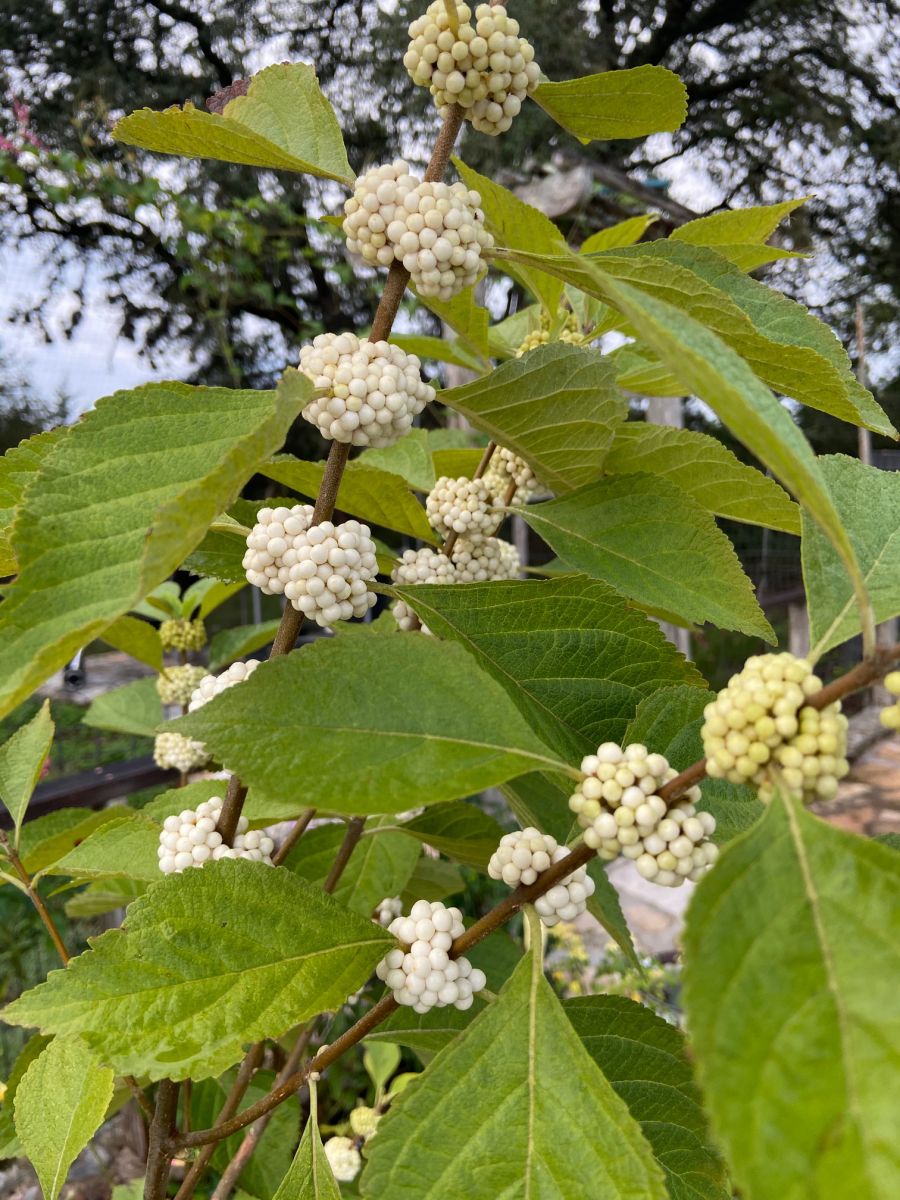
White Beautyberry photo by Roberta Churchin
Cooking with American Beautyberry Making the berries into jelly brings out the stronger flavor of the berries than when they are raw. In general the comments on most sites about make jelly suggest the flavor is mild and floral, similar to elderberry or even rose petal jam. When the juice is more concentrated it can have a tart note.
There are basic (but hard and fast) recipes for making a good jelly, and if for some reason yours doesn’t set properly, it can be used as a syrup over pancakes, pound cake, ice cream, and more. The low-tech approach is to process the berries by simmering them in a pan just covered with water for 20-30 minutes. The cooked berries should be mashed, but in such a way that the seeds inside aren’t broken (don’t use a powerful blender on them, use a potato masher or a wooden spoon) then decant the fruit and juice through a seive lined with cheese cloth. Adjusting the acid level by adding lemon juice to the concentrated berry juice brings out the red color. A better alternative requires the use of a steam juicer to get a richer, more concentrated and better-colored juice. Steam juicers can be expensive but they are an essential tool for serious jam and jelly making and for juicing other fruits and vegetables. They’re great for making cranberry juice.
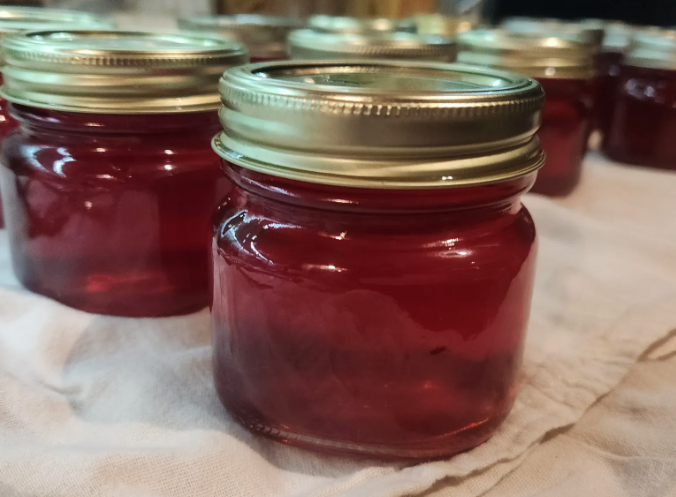
Since the Sure Jell pectin box instructions won’t have a line for American Beautyberry, it may be best to treat these with the instructions for the default grape jelly recipe (five cups of juice, seven cups of sugar) for cooked jelly. If you’re not sure you’ll manage the recipe correctly (it is important to follow the steps and time to the letter on the package insert for successful jelly) or if it doesn’t set properly, then use it as syrup or treat it like freezer jelly instead.
Below are links to recipes for American Beautyberry “jam” or jelly, but each cook fiddled with the jelly recipe, so your outcome isn’t guaranteed. It is helpful to read through to see what steps they took to prepare the juice and how they dealt with non-setting jelly.
The most authoritative recipe source, and made with a steam juicer: https://hambonesmarket.blog/2023/09/29/__trashed-2/ Jelly jar photo credit to the Hambones Market site.