
Bagworms – Organic Answers Column January 22, 2025
Bag the Bagworms
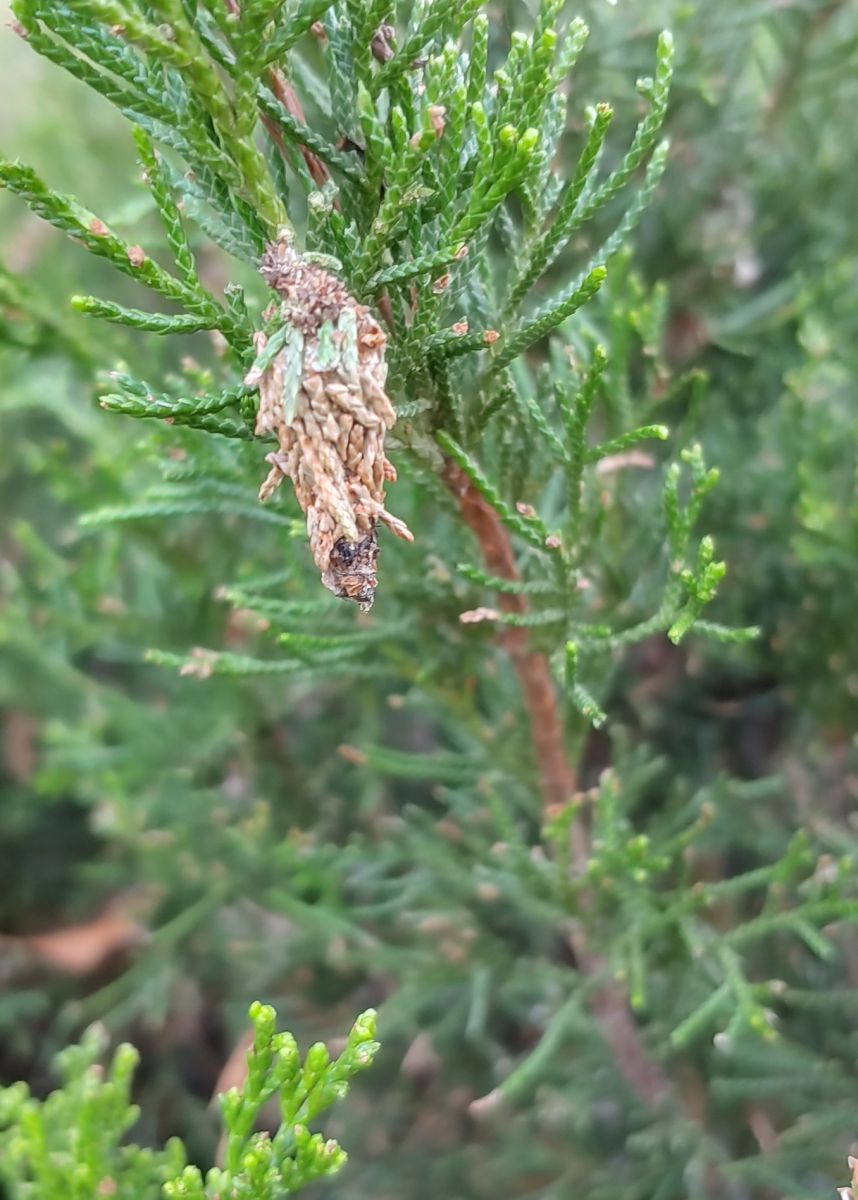
Juniper bagworm building bag.
Did you know that if you get out in the yard now during the winter months and pull any old bagworm bags off of your evergreen junipers, or other affected plants, that you may have fewer bagworms during the year? That’s because you’ll be removing the eggs that are overwintering in the bags that will hatch this spring. The bagworm moth has a complicated life cycle in which only the males fly and the females spend almost their entire lives inside the bags they construct around themselves as soon as the larval state leaves the bag they hatched from.


Early stage Bagworms in a Mexican Buckeye
The bags, camouflaged by the worm with twigs and pieces of the plant it was eating, overwinter the eggs laid by last year’s female worm. The completed bags range from 1½ to 2½ inches long. Adult females are grub-like, have no wings or eyes, and are nearly hairless. The rarely seen male adult is a small flying moth with clear wings and feathery antennae and is sooty black. In some bagworm species, the female lays eggs in the bags in the fall, then goes through the lower opening and drops to the ground and dies. Generally in the spring larvae hatch and lower themselves on silk threads and attach on limbs where they start building their own silk bags. Those newly hatched bagworm larvae make conical bags that they carry upright as they move around the tree they’re feeding on. In other instances, according to the Ohio State University Extension office, “After mating, the female literally mummifies around the egg mass, which remains in place until the next spring.”

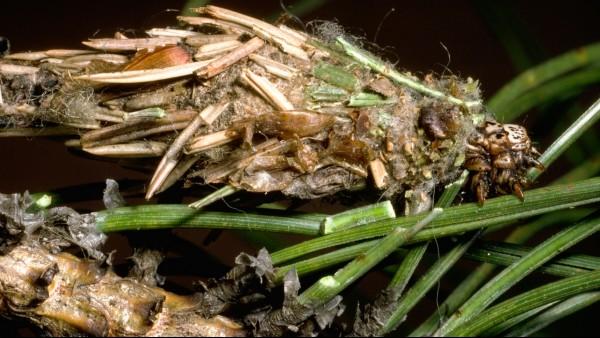
Male (left) and female bagworms. Males can fly, females stay in the bags they construct, but poke
out to move and eat. Both photos U of Maryland Extension
In spring males emerge after a few weeks in their bags and fly around looking for females who attract them by releasing pheromones.

Newly hatched bagworms with their conical bags in upright positions, before attaching
Plants where bagworms can be found include willow, cedar, cypress, baldcypress, some pines, boxelder, locust, sycamore, maple, sumac, persimmon, and more. As with other pests infestations, the plants they attack may already be stressed. Bacillus thuringiensis (Bt) during their active months or dormant oil in winter can be used to kill them. Trichogramma wasps released at the time of leaf emergence can also prevent them. The most efficient method of treatment if you can reach them all is the mechanical approach – pull them off by hand. They can be buried in the compost, or but according to the University of Maryland Extension, “don’t throw them on the ground near the trees, destroy them and throw in the trash.” (During the growing season they’ve been seen to crawl off to other plants when pulled off of the original location and dropped.)
The lifecycle of one variety of bagworms is decribed in detail at the Texas Agrilife site:
Full grown caterpillars within bags are up to 1 inch long before pupating in August or September. Seven to 10 days later, the pupae of male moths wriggle out of the bottom of the bag before the male emerges, leaving the empty pupal skin behind. . . . They fly and seek out a female to mate. Females do not develop into moths, but remain inside bags and resemble maggots, with no functional eyes, legs, mouthparts or antennae. After mating, females produce a large clutch (500 to 1,000) of eggs.

The bagworm silk can girdle the branch as it grows.
However you get them, preventing the worms from eating the tender branches and buds causing defoliation or dead areas on the plants. A note from Ohio State about the bag attachments themselves:
The mature larvae usually attach their bags to a branch by wrapping extra silk, which does not decay rapidly. This band of silk may girdle the branch as it grows, resulting in dead branches several years later. Be sure to cut off this silk band when removing bags from a plant.
For more information, see https://texasinsects.tamu.edu/lepidoptera/bagworm/,
https://ohioline.osu.edu/factsheet/HYG-2149-10,
and https://extension.umd.edu/resource/bagworms-trees-and-shrubs/.
