
Dallas Morning News – August 6, 2020
Green Lacewings
Identifying strange critters and creatures in the garden has become one of my common jobs. Often the photo quality is less than ideal and it’s hard, but the latest one was so clear, the mystery was easily solved.
 Green lacewing adult |
These are the eggs of the green lacewing – one of our most important beneficial insects.
Adult lacewings are lacy, light green or brown, have lustrous eyes, long antennae and heavily veined wings. Adults hold wings in tent-like fashion while at rest. Brown lacewings are smaller and their eggs are not on stalks. Larvae look like tiny alligators with sickle-shaped jaws.
 Green lacewing eggs, not yet hatched |
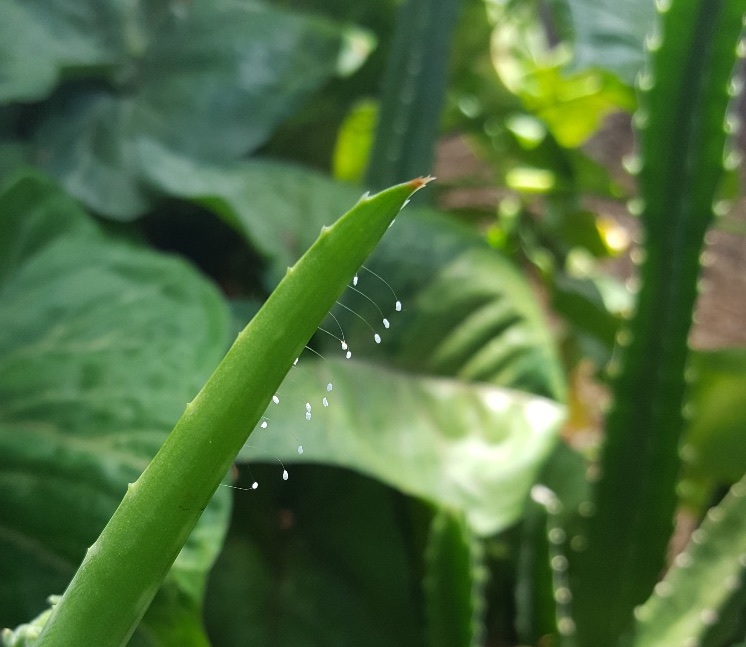 Green lacewing eggs on aloe vera (photo by Kim Blythe) |
Adults help pollinate plants and normally feed on nectar and honeydew or possibly take no food. They are active fliers at night and can be mistaken for moths. Females lay several hundred eggs in spring and summer that are connected to the end of long whisker-like silk stalks (singly or in clusters) on limbs, twigs, leaves, or even inorganic objects such as the front door or equipment in the shed. Brown lacewing eggs are not on silken stalks but attached to surfaces. Before hatching the eggs are off-white and smooth. Hatched eggs are white and look like popcorn.
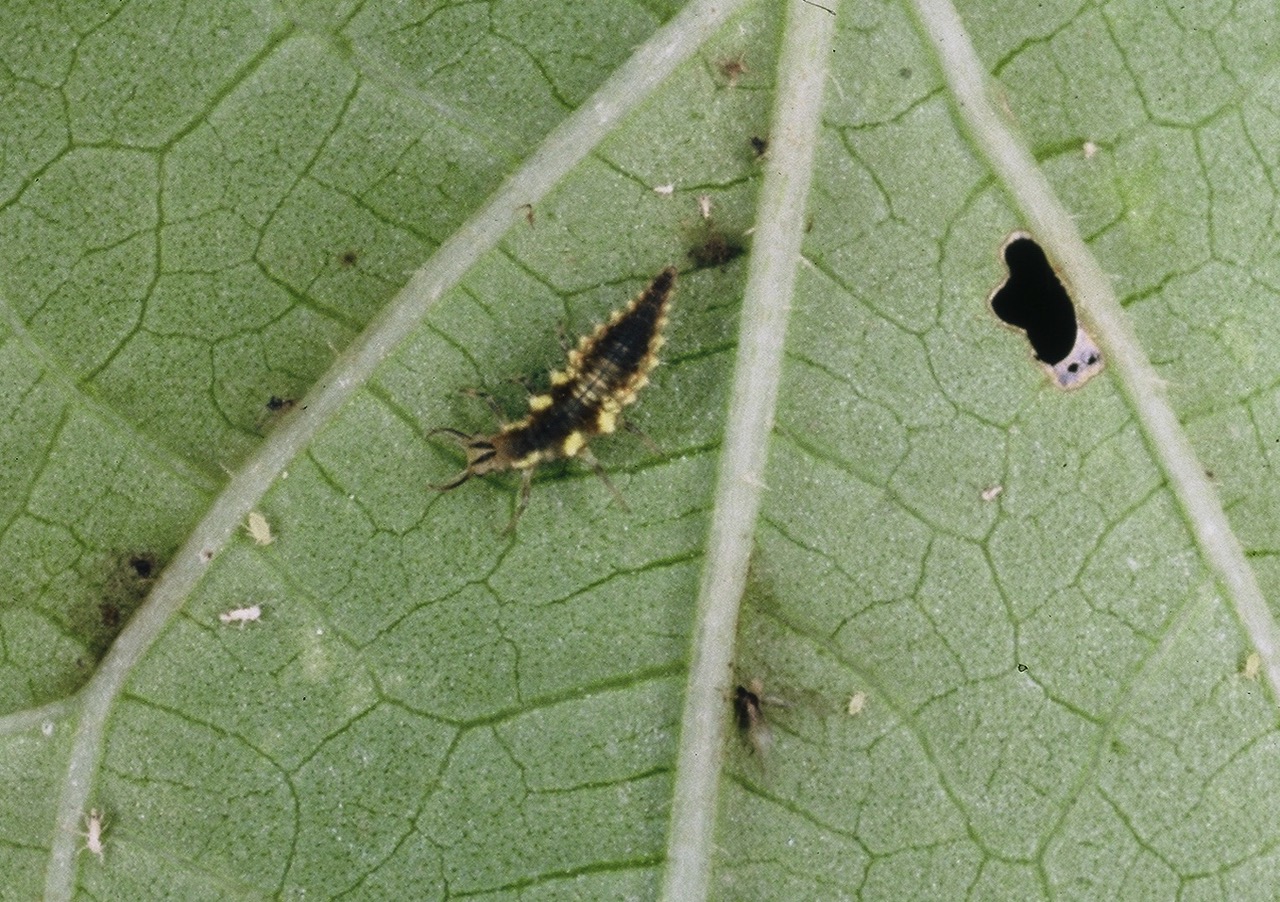 Green lacewing larva feeding on small insect pests |
The little alligator-looking larvae are pinkish brown and very mobile, progressing through three instars in two to three weeks. They pupate in the silken cocoons and emerge in about five days by cutting a hole to escape. They overwinter as adults or cocoons and have three or more generations a year.
Larvae or “aphid lions” feed on aphids, thrips, mites, mealybugs, scale, whiteflies, eggs of leafhoppers, moths, cabbage loopers, corn earworms, Colorado potato beetles, asparagus beetles, leaf miners, and several small caterpillars and beetle larvae.
 Brown lacewing adult |
 Green lacewing adult |
Green lacewing larvae and eggs can be purchased commercially, but if you are using an organic program, they will just show up at no charge. If purchased, larvae and eggs are the most practical to use. Even if released in the wrong place, they will travel some distance if necessary for their first meal. Watch out for fire ants; they will eat the eggs like jellybeans. Broadcasting dry molasses at 20 lbs. Per 1000 sq. ft. usually solves that problem. Releases of 2,000 to 4,000 eggs per residential lot or per acre is ideal.
Brown lacewing adults look and behave very much like green lacewings, but they are tan not seen as often. Like green lacewing larvae, brown lacewing larvae are predators, but some species cover themselves with plant debris and the skins of their prey as a way to protect themselves from larger predators. They are called “Trashbugs.”
 Brown lacewing larva or Trashbug |
 Trashbug – Brown lacewing larva |
All the lacewings are desirable but delicate – another strong reason to avoid spraying toxic chemical products. Learn more about the pest insects and these helpful beneficials in the Texas Bug Book by Garrett and Beck.