
Dallas Morning News – April 19, 2018
IRRIGATION SCHEDULES AND PROBES

Pipe probe
What’s a good watering schedule – how often and how much should I water. My answer is – I don’t have a clue. Homeowners and commercial landscape managers want to be able to set the automatic sprinkler system on a program that will allow them to walk away and forget about watering. That’s a bad idea in many ways.
Every site varies because of soil type, slope, drainage, sun exposure, temperature, kind of plants, kind of mulching, etc. Therefore, my recommendation is to leave irrigation clock on “manual’ so that the only time it runs is when you push the “start” button. Same goes for watering with hoses and portable sprinklers. It’s a little more trouble but your plants will fare better and the water bills will be lower.
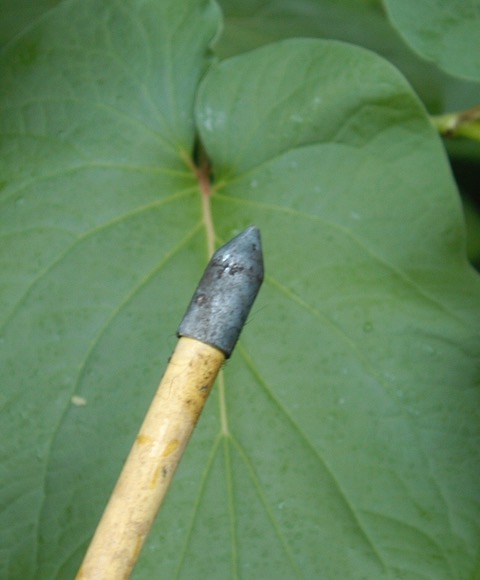
Bullet point on pipe probe
There is a great tool for testing the soil moisture to see if watering is needed. It’s called a soil probe. Commercially referred to as a pipe probe, this tool is made by several companies such as Structron. They are about 4 feet long fiberglass rods with metal bullet tips and rubber handles. By probing the soil, you can tell instantly whether the soil is too dry or too wet. The probe can also be used to find pipes or underground obstructions such as rock and concrete. Girdling roots on trees can also be detected without digging. These tools usually run in the $20 – 40 range.
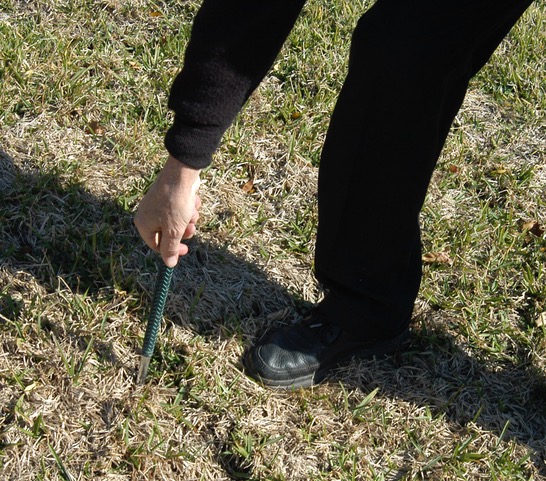
Golf club being used as a soil probe
There are no dials or gauges. Using the probe is done by feel. If the soil is too dry, the probe won’t go in the ground easily. If the soil is too wet, the probe will sound like a cow pulling her foot out of the mud as it comes out. If just right, the probe moves easily through the soil. If the probe hits something hard, it could be rock, buried construction material, tree root or hardpan caused by poor management in the past. Digging is required to figure which of these is the culprit. Hardpan is the serious concern. It is a compacted layer of soil that must be physically penetrated and broken up so that drainage works and tree roots can be healthy.
For an even more affordable version of the soil probe, break the head off an unwanted golf club. Even better is to use a hacksaw to make a clean biased cut. What you should not do is use a probe that is all metal such as those made of re-bar and not having rubber handles. They are very dangerous because electrical lines may be waiting for you!