
Dallas Morning News – June 21, 2018
Maples for North Texas – Poor, Good and Better Choices

Bigtooth maple
The red maple (
Acer rubrum
) that puts on a show nation-wide in the fall doesn’t do very well here in our alkaline soils, but there are other maples available for use here in North Texas. Some are good choices, some are poor choices.

Caddo maple
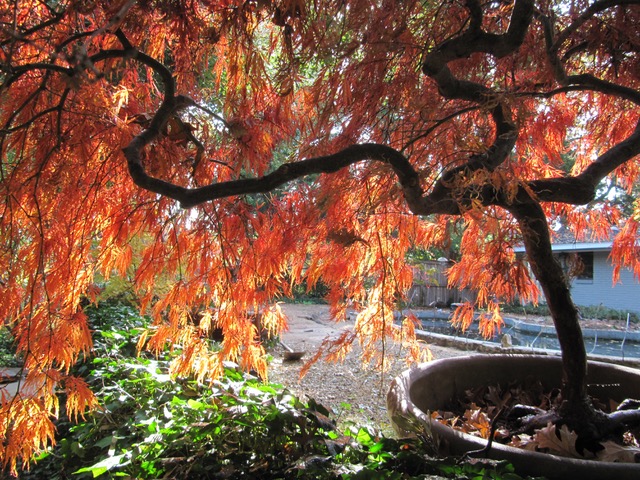
Japanese maple, Crimson Queen

Japanese maple, Orangeola
The most commonly sold maple here is silver maple – a bad choice. Lots of built in problems, the main being a short life span. It is fast growing but has brittle wood and has a general weakness that makes it susceptible to several insect and disease issues. Other commonly used maples to skip are the hybrids such as October Glory and Autumn Blaze. They are manmade failures in my opinion – susceptible to insect pests and diseases, as well as chlorosis in higher pH soils. Their thin bark is highly susceptible to sunscald and these trees are very short lived here. Maybe they work better somewhere else in the country but I doubt it. I learned the hard way years ago after designing several of them into commercial projects.

Paperbark maple
In the recommended maple category we have the following to pick from – bigtooth, Caddo, Trident, shantung, paperbark, Mexican mountain and Japanese. Bigtooth maple is the true Texas native. I used to say it was slow growing, but after growing them I got smarter. Caddo is the Oklahoma native. It is slower growing and has less impressive fall color than bigtooth. Trident maple, an Asian import, is relatively fast growing but has weaker weaker fall color. Shantung maple is also from China but performs much like a native. It is moderately fast growing and has golden fall color with hints of red. Paperbark maple is a lovely medium-sized maple to try. Buds in spring look like pussy willow and it also has deep red fall color. The Japanese maples are a large and diverse group and I like almost all of them. The ones in my favorite column include – the large-growing green species plant (Acer palmatum) that is the mother plant for many of the hybrids. I have several of these. They are tough, can take more full sun than other Japanese maples but can be hard to find in the nurseries. My oldest Japanese maple is Crimson Queen that is a lacey-leafed A. dissectum species. We have had it in a pot (stepped up in size 3 times) for almost 40

Trident maple
years. ‘Orangeola’ has also done well in a pot. The only Japanese maple I’ve had trouble growing is ‘Coral Bark’ – beautiful, but tricky.

Silver maple