
Dallas Morning News – February 20, 2020
Mulching – Advanced Degree
In the early days, my advice on mulching was bad – then it got worse. Learning from mistakes, my recommendations are now quite good.
 Proper tree mulching – thin and off the flare |
Evolution of my mulching knowledge began by listening to nurserymen and landscape contractors who thought mulching was unimportant. Philosophy in those days was to stick the plants in the ground, water and walk away. Later we all “advanced” into the concept of tossing a little pine bark around new plants. Better than bare soil – right? At least it looked like we were doing something to help the plants and create a more finished look to impress the customers.
For some years I did as I was told and mulched at least some of the bare soil with pine bark which was easily available and inexpensive. Using it in landscaping also served the purpose of getting rid of a waste product so suppliers started pushing the idea.
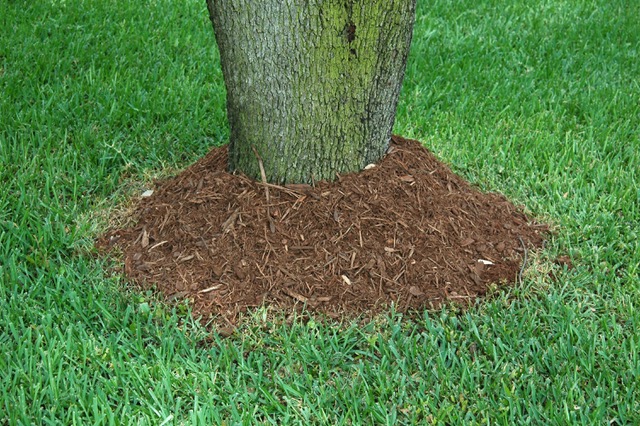 Destructive and unexplainable tree mulching |
 Very bad tree mulching – dyed wood and piled up on the trunk |
Only problem was that pine bark is one of the poorest mulch choices. Yes, it’s better than shredded rubber, dyed wood scraps, or leaving bare soil exposed to sun and wind, but, pine bark has some bad properties including nasty natural chemicals (terpenes, phenols, etc.) that effect plant growth and it blows and washes and won’t stay in place.
Mulching trees is where the worst mulching mistakes are made. I, like many gardeners and landscapers, decided next that more mulch is better and began putting a thick layer across the entire planting area. That technique puts the same thick layer of mulch up onto the flares and trunks of trees. That’s bad because moist mulch prevents bark from breathing properly, just as moist soil does.
 Horrible “volcano” mulching |
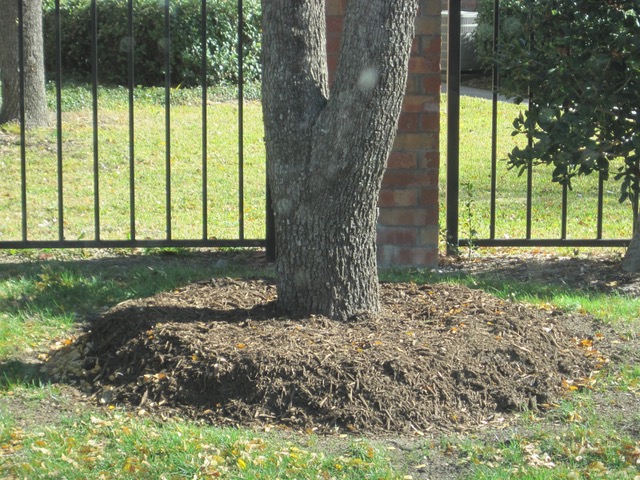 Very bad tree mulching – thick all the way across and covering the flare |
The best plan for mulching trees is to apply about 2″ of shredded native tree trimmings mulch at the outside edge of the tree planting hole and lessen the thickness of the mulch layer as it gets closer to the tree trunk. At the trunk the thickness of the mulch should be 0″. No mulch on the flare in other words – just bare soil for a few inches around the trunk.
“Volcano” mulching is in class by itself. As far as tree planting and tree management, few techniques are worse horticulture or uglier. The only thing worse for trees than piling the mulch up on the trunks is putting plastic on the soil under the mulch.
A perfect example of this big mistake can be seen in north Dallas. Bald cypress trees planted along Central expressway (75) are continuing to suffer, many have died and more are dying due to the plastic fabrics applied on the ground before mulching. It was done for weed control – I suppose. As many people have now seen from this train wreck of a project, plastic sheets don’t control weeds, but do hurt the soil and roots of trees. So – don’t do that.