
Queen Anne’s lace

COMMON NAMES: Queen Anne’s Lace, American Wild Carrot
FAMILY: Apiaceae (Carrot) formerly Umbelliferae.
This lacy weed-like plant got its common name from the legend of Queen Anne of England (1665-1714) pricking her finger and a drop of blood landing on white lace she was sewing. Part of the carrot family, Queen Anne’s lace is a biennial that is also known as wild carrot. Early Europeans cultivated it and Romans ate it as a vegetable. American colonists boiled the taproots, sometimes in wine as a treat. It is high in sugar, second only to beets among root vegetables. It was used by many cultures across Europe and the Indian sub-continent to sweeten puddings and other foods.
From Wildflower.org:
Q: I am trying to identify a plant/weed that grows here in Austin but I haven’t found an exact match in your databases. It looks very similar to Queen Anne’s lace and to your photos of yarrow but the leaves are not feathery. It has a long skinny stem topped by tiny snowflake shaped flowers. Few leaves that are serrated but not fern-like. Any ideas?
A: My best guess would be the native, Daucus pusillus (American wild carrot). It is actually the same genus as Daucus carota (Queen Anne’s lace), the European and southwest Asian species that has been introduced into North America and it looks very similar to it. Here are more photos of Queen Anne’s lace and of American wild carrot (also called Rattlesnake Weed) for comparison’s sake.
The Queen Anne’s lace flowers resembles white lace and have a flat-topped white umbel, sometimes with a solitary red-purple flower in the center. The flowers bloom from late spring until mid-fall. Each flower cluster is made up of numerous tiny white flowers. The flower cluster start out curled up and opens to allow pollination. The cluster then rolls itself shut again, like a reverse umbrella when it goes to seed at the end of the season. The root smells like carrots.
Feathery leaves resemble the domestic carrot. The bases of leafstalks are broad and flat. Queen Anne’s lace leaves also closely resemble the leaves of the poison hemlock, fool’s parsley and water hemlocks, all poisonous cousins of Queen Anne’s lace. See below. Wild carrot can grow tall, most average about 3 feet tall.
If you can positively identify the plant you are using, it is edible and using first year plants are recommended. Roots are used in soups, stews and in making tea. First year leaves can be chopped and tossed into a salad. Flower clusters can be “french-fried” or fresh flowers can be tossed into a salad. The aromatic seed is used as a flavoring in stews and soups.
Recommended control: This and many other tough undesirable plants are best controlled with physical removal and the use of vinegar and fatty acid products on regrowth.
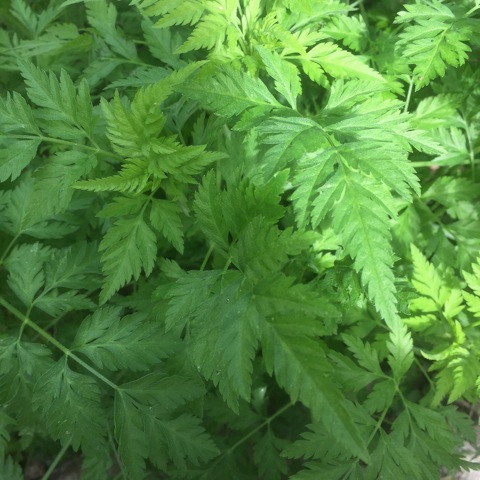
SIMILAR PLANTS
Poison Hemlock (Conium maculatum) HIGHLY POISONOUS
Poison Hemlock also has large white flowers. The difference is that the Queen Anne’s Lace flowers occur much tighter together. Also, Queen Anne’s Lace flowers often have a solitary reddish-purple flower in the center. Another difference is that Queen Anne’s Lace root smells like carrot.
Fool’s Parsley (Aethusa cynapium)
Fool’s Parsley also has large white flowers but Queen Anne’s Lace flowers occur much tighter together and have a solitary purple flower in the center.
The best way to distinguish the two is to smell the root of the plant, since Queen Anne’s Lace root smells like carrots.
For more information about American Wild Carrot (Daucus pusillus) visit the Lady Bird Johnson Wildflower Center listing and for Queen Anne’s Lace see the University of Wisconsin Horticulture extension page about Daucus carota.