
Dallas Morning News – February 10, 2022
Worst Texas Trees and Why
Lots of trees will grow well in Texas, but some are not great choices. Here’s a review of some common ones I recommend you avoid planting and even removing in most cases.
Arizona ash has pretty yellow fall color some years but is short-lived, a heavy water user, has destructive roots, is subject to several insect pests and diseases and can suffer freeze damage.
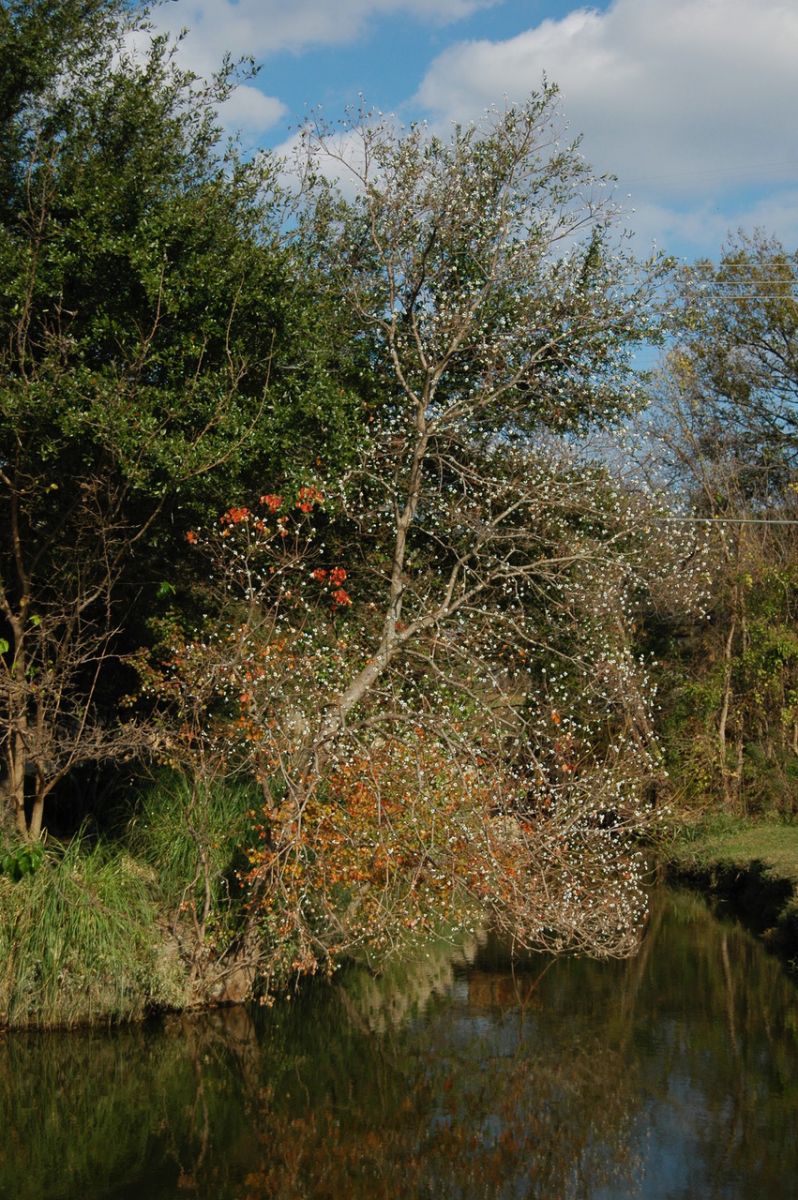 Chinese tallow trees have pretty red fall color and interesting white winter flowers but are invasive and subject to freeze damage |
Chinese tallow grows fast, has pretty fall color and white fruit but freezes back in hard winters, has several insect and disease issues and is generally short lived.
Cottonwood trees grow big and beautiful when healthy but are a bad investment, especially for residential use. They have brittle wood, are subject to wind damage, insects, – especially borers – and the female plants produce messy cotton fruit that clogs air conditioners and other equipment. Luckily, they are short lived. Like Arizona ash, cottonwoods are beautiful and appropriate in valleys along streams and rivers but not in your or your neighbor’s landscape.
Siberian elm is one of the worst choices. Incorrectly called Chinese elm, it has severe elm leaf beetle infestation every year and is susceptible to Dutch elm disease. Wind damage due to weak wood is also a problem.
Honeylocust continues to be used but borers love it and it just never seems to be healthy here. The native version has extremely vicious thorns, but even the thornless hybrids are poor choices.
Hackberry is big weed that pops up everywhere. It is short lived and fraught with insects and diseases.
Fruitless mulberry is a fast growing and fast dying junk tree. It shades the ground too heavily, uses too much water and is the target for several insect pests and diseases. Its root system is highly destructive to lawns, walks, driveways and pipes.
Pin oaks are beautiful and grow well in acidic, sandy soil but a big mistake to plant in alkaline, clay soils – like most of North Texas. It cross breeds with and contaminates other oaks to create problems. Red oaks accidentally crossed with pin oak will usually turn sick yellow and perform poorly in alkaline soils.
Poplars in general are fast-growing, unhealthy trees and should be avoided. Lots of insects and disease problems and root suckering is a common and unsolvable problem.
Silver maple can become a large, beautiful tree, but it usually develops chlorosis from trace mineral deficiency. Is subject to insects and diseases and has weak, brittle wood. Not a good investment.
Sycamore trees are gorgeous when healthy, but diseases are a concern. Unless watered properly, anthracnose and bacterial leaf scorch can occur. Mexican sycamore is better than American sycamore.
 Cottonwood is a large, beautiful tree in its natural habitat but too large and problem prone for residential property |
_has_large_dramatic_leaves_and_showy_flowers_-_but_it_is_highly_invasive_and_problematic.jpeg) Tree of Heaven (Ailanthus) has large dramatic leaves and showy flowers – but it is highly invasive and problematic |
Tree of Heaven or Ailanthus grows easily pretty much anywhere, including places and spaces where not wanted. It has dramatic foliage and flowers but now widely considered invasive. It has such an interesting history, it deserves an entire column that I promise to write.