
Organic Answers Column – April 13, 2022
A Solution for Italian Cypress and Other Stressed Trees
When selecting trees to plant in a garden – mine or a client’s – would I choose to use Italian cypress? No. These dramatic trees come with some standard health problems, though they are treatable. The solution is the same we have used successfully on other disease issues – such as oak wilt, rose rosette, photinia leaf spot (entomosporium) and other so called “hard to control” diseases. The Sick Tree Treatment.
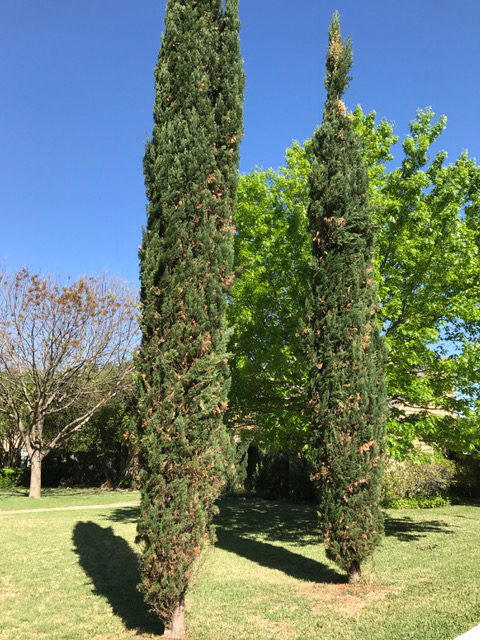 Italian cypress canker |
 Close look at Italian cypress canker |
As tree choices go, Italian cypress trees are not well-suited for the Dallas/Fort Worth area, so have several built-in issues. They would much prefer the milder weather and the arid hillsides of Italy or Greece. They are susceptible to mites and bagworms when in stress and root rot disease can be a problem in poorly-drained soil. The biggest problem they experience here is a fungal canker. It is a devastating disease that has deformed and killed many trees, especially on sites where the drainage is not sufficient. Over-watering is also a common mistake and a common cause of problems. Fungal diseases hit plants that are in stress from soil related or environmental problems and when we experience heavier than normal rains those also part of this story. There are sprays such as hydrogen peroxide mixed 50/50 with water that can be used to knock the disease back but you have to eliminate the cause of the stress or the disease will return. The most common cause of stress is the tree being too deep in the ground.
 This tree has no trunk flare showing |
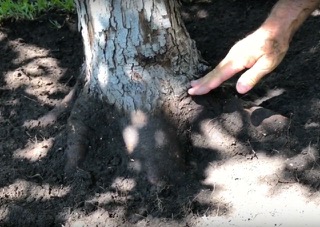 About six inches of soil was removed to expose the flare |
As is the case with many planted nursery trees, almost all Italian cypresses have been planted too deeply, resulting in tree health problems. They are usually too deep in the containers when purchased from the nurseries, so they get planted too low and then have too much mulch added on top. The result is severely buried flares. The flares are part of the trunks (not the root systems) and should be exposed to air. Called either root flares or trunk flares, this part of the tree should be dramatically exposed, not just barely exposed.
 A stiff brush can remove soil without damaging roots |
_with_a_large_garden_knife_or_chisel.jpg) Carefully loosen soil if using a gardening knife |
If you are very careful, this exposure can be done with hand tools and a leaf blower. This is the first part of the Sick Tree Treatment that is recommended for many tree problems. The rest of the STT is to aerate the root system and then while the punched holes are still open apply all the basic amendments we organic gardeners use for bed preparation: quality compost, lava sand, green sand, whole ground cornmeal If you need professional help make sure to hire a tree care company that understands the importance of exposed flares, has an air spade and uses organic techniques.
