
Organic Answers Column – March 30, 2022
Compost Making—A Great Plan
An unfortunate development in the world of commercial compost is that many of the commonly available commercial composts are subject to being contaminated with long-lasting herbicides (specifically picloram and clopyralid). To avoid the impact on your garden, it is a good idea to start your own compost making operation. It’s actually pretty easy.
You can start a compost pile at any time of the year, so now’s as good a time as any in a location that is convenient. Some books and instructors say it must be in the sun the covered with a tarp in the winter to hold in the heat, but both are silly recommendations. The biological activity that is the actual composting process goes on down inside the pile in the dark. It’s OK to have the pile in the sun, but it is equally OK to have it in the shade of trees or even in the garage.
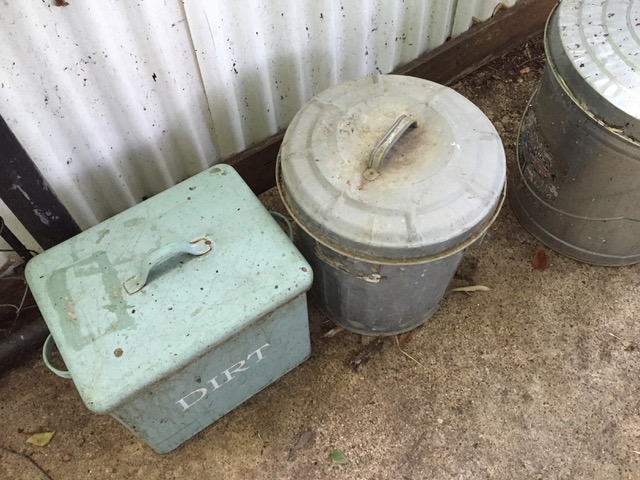 Some of my various metal containers for the fresh food waste |
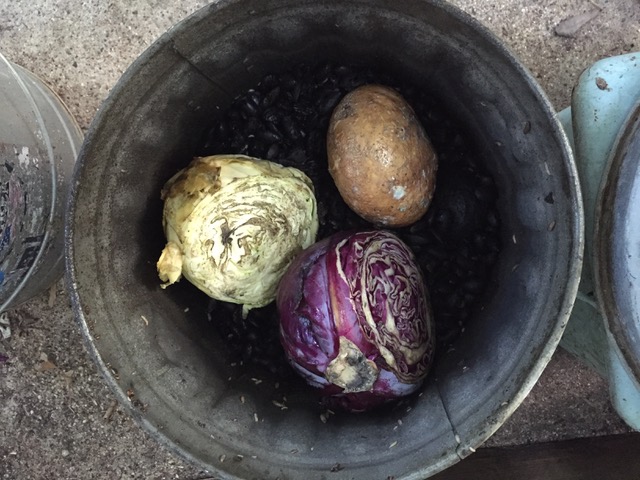 Food waste should go into metal containers with lids first and moved to the big pile later to avoid attracting wild animals |
What should be added to the pile? Anything once alive can and may be used in the compost. Good ingredients include leaves, grass clippings, tree trimmings, weeds, food scraps, dead animals, bark, sawdust, rice hulls, weeds, spoiled food, nut hulls, and pet manure. Don’t use hay (sometimes treated with picloram or clopyralid) to avoid the possible contamination that commercial operations are struggling with. The ideal mixture is 80% carbon (the dry brown stuff) and 20% nitrogen (manures, green plants, food products and organic fertilizers), although any ratio will breakdown in the compost. There should be a mix of coarse and fine-textured material. Avoid having it all the same since large particles help aerate the pile and smaller pieces are needed to help hold moister and protect microbes.
Mix the ingredients together in a freestanding pile, as I do often, or use containers such as hog wire, concrete blocks, etc. Unless space is limited, freestanding piles are preferred. If containers are desired, the best for the money is a sturdy wire composter like the Sheppard Composter, made of steel mesh, easy to use and folds for storage. Unfortunately the Sheppard device is no longer on the market. I am trying to get a greenhouse company to start making an even better version. We’ll keep you posted.
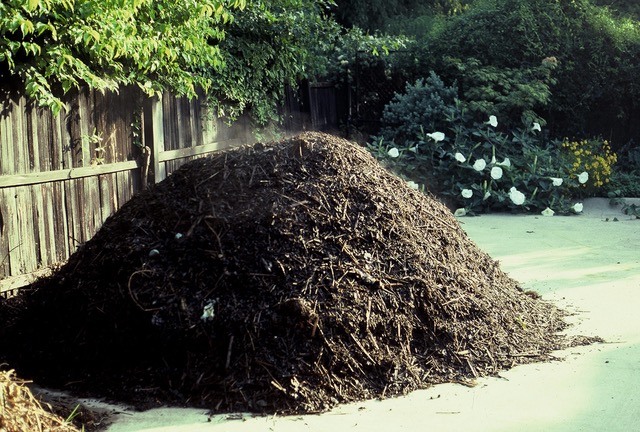 Freestanding piles using large amounts of shredded tree trimmings are excellent |
 Finished compost looks good and smells like a forest floor |
Turning the pile at least once a month helps oxygen enter the mix to speed up the process. Keep the pile moist, roughly the moisture of a squeezed-out sponge, so the living microorganisms can thrive and work their magic. If you never turn the pile, it will still compost – just slower. To encourage a higher percentage of fungal activity (a good thing) compared with bacterial activity, add rock phosphate and keep the pile drier.
If you purchase commercial compost, try to buy a product made from shredded tree trimmings. Without manure in the mix there is little chance of the herbicide contamination (the picloram and clopyralid don’t break down substantially even when animals digest them). And note – a pile of shredded tree trimmings left in place for at least 9 months will break down into beautiful compost.
Compost is ready to use when the ingredients are no longer identifiable. The color will be dark brown, the texture soft and crumbly and the aroma that of a forest floor. Use compost in all bed preparation and as high-quality mulch around annuals, perennials and other small plants.
 The best container for home or composting is this something like the (now discontinued) Sheppard Composter |
For gardeners wishing to confine the working compost, making your own free-standing container like the Sheppard Composter is a matter of patience and finding the right kind of stainless steel hardware cloth. To turn the compost, simply lift your cage and move to a new location and then toss the ingredients back into the cage. This creates all the turning that is needed. Batteries of these containers can be used for large operations. I usually don’t use the aeration device shown in the center of the pile – it’s too much trouble.
For more information about herbicide contamination in commercial compost visit https://www.the-compost-gardener.com/picloram.html
