
Organic Answers Column – June 7, 2023 – Planarians
Flatworm or Land Planarian
An unusual worm has been in the news recently. It may be in your garden and you need to know about it. You also need to kill it. It’s a flatworm, also called the land planarian, a slimy iridescent flatworm with a hammer head. At one time I thought that it was a neutral animal in the garden – eating some beneficials and some pests, but that is wrong. Rather than helping control termite larvae, grubs and other pests, etc. it seems that it is only a destructive pest that needs to be gotten rid of. It only eats earthworms.
The predatory land planarian, also called a terrestrial flatworm, is no friend of earthworms. In fact, they are parasites that eat earthworms and can wipe out entire populations.

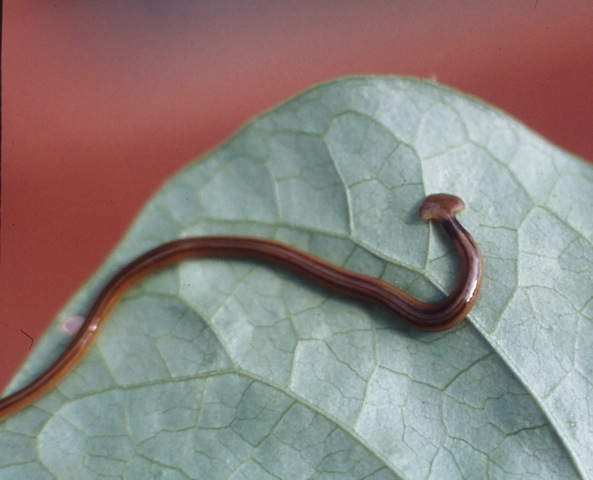
These non-segmented flatworms – cousins to the tapeworm – can stretch out up to 20 inches long, gliding along on a layer of mucus secreted from glands along its underside. This gruesome worm feeds by extending its throat (pharynx) out of its mouth and into the earthworm. Small bits of the earthworm are dissolved and swallowed a little at a time.
Many land planarians are native to Indo-China, and were transported to other parts of the world in the soil of greenhouse plants. They can survive in freezing climates but don’t do well in dry climates. They are primarily nocturnal, but can often be found out and about early in the morning especially on wet surfaces. They can also be found on the trunks of trees.

Diagram of land planarians from Asia – from Wikimedia
The impulse to smash this pest would seem to be the thing to do, except for the fact that it grows back from small pieces. The better choice is to spray it with orange oil to completely destroy it and prevent regeneration.
Two types of flatworms have been seen in the Dallas area. One type is medium-brown and has dark stripes and a hammer-shaped head. The other is dark brown with a pointy head and is thinner than the first type. Neither of them is beneficial.
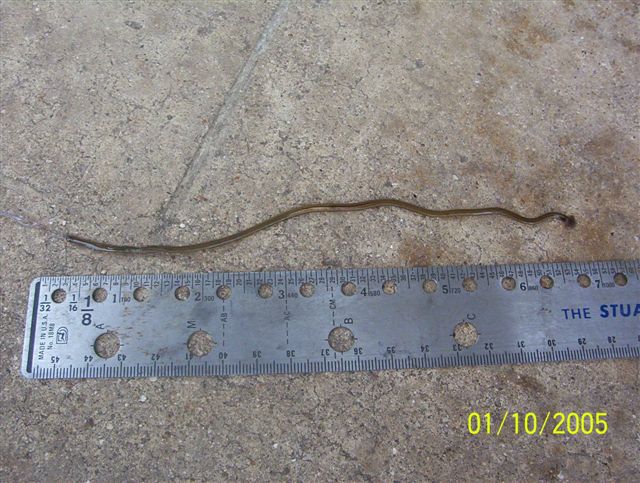
These invasive flatworms are native to Asia but have been transported to other parts of the world in the soil of greenhouse plants. Both of them are destructive to earthworms. Spraying with an orange oil and vinegar formula (the same one you use on weeds) will probably will kill them. You could also probably use full-strength hydrogen peroxide to do in this little beast. Melting flatworms completely is important because if they are chopped up, every piece will regenerate into a separate worm. Whatever way you choose to kill them, put the entire carcass in plastic in the trash so they can’t grow new worms from any remaining parts.
