
Organic Answers Column – March 8, 2023 – Zeolite
Zeolite

Zeolite granules
Zeolites are natural minerals known as alumino-silicates are formed from igneous rocks that had been exposed to steam or hot water which caused open pores in the minerals structure. This unique porous structure allows zeolite the ability to absorb water even under dry conditions, and/or absorb huge amounts of gases and/or minerals and keep them readily available for plants.
It is often used as cat litter as it absorbs odors and as an ingredient in animal feed. When used as a soil amendment it increases the CEC (cation exchange capacity) of the media. Over 48 types of Zeolites have been found in the USA all with similar properties.
The name Zeolite comes from the Greek “Zeo” (meaning to boil) and “Lithos” (meaning stone). In gardening, the unique structure allowing zeolites to:
• absorb and release water molecules (strong capillary action) and hold water up to 26% by volume
• hold and release plant nutrients since it has a high cation exchange capacity (CEC)
• improves porosity (aeration)
• support microbial activity
• buffer pH
• reduce clay clumping
• absorb odors
• absorb ammonium (NH4+), thus keeps nitrogen from escaping into the air or leaching
• readily available and relatively inexpensive
• typically applied at the rate of 30-100 pounds per 1,000 square feet

Zeolite is great for absorbing ammonia in horse – or cat – environments
It has a wide range of uses, such as the following:
• detergents
• animal feed
• golf course greens and tees construction and management
• potting soils
• cat litter (several brands are 100% zeolite, so read the label)
• eliminating pet urine odor and plant burn
• used in soil wetting agents
• air and water purification
• spill absorbents
• absorbs heavy metals hence used to detoxify
• crude oil cracking
• pharmaceuticals and cosmetics
• water softeners
• filter media in aquariums
Zeolite is a natural volcanic mineral. The formal name is Clinoptilolite. It contains a wide array of basic minerals that were spewed back to the earth’s surface after a volcanic eruption. Over millions of years, hot springs leached the calcium, sodium and other contaminants out leaving a unique material. Finely ground zeolite has an amazing capacity to grab things – odors in the air – all kinds of odor, and contaminants in soil and other materials. It especially likes ammonia – raw nitrogen. So, if you’ve been using synthetic fertilizer, an application of zeolite will grab that excess nitrogen and release it slowly so it is useful to plants — and isn’t leached into our water systems.
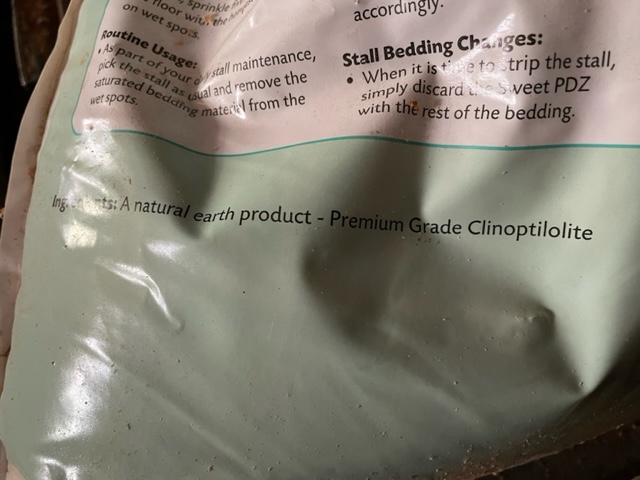
Clinoptilolite (in this Sweet PDZ product) is the most abundant form of Zeolite.
Its capacity to grab odors makes it a great material in cat litter. And, it’s the crunchy material that comes in those little bags that are sold to absorb odors in refrigerators, closets and such. And it’s reusable. I bought a chunk of it at an aquarium shop. I keep it in my aquarium with my albino frogs. Periodically, I put it out in the yard in the fresh air and sunshine where it releases the absorbed odors. Then I put it back with the frogs. This is a very useful product in the organic program.
Zeolite can also be used for air and water purification, cat litter material, shoe deodorizers, animal feed supplements, garage floor spill removers, cooler and refrigerator odor and moisture removers, animal stall odor and moisture removers, and soil amendments.
Mix raw zeolite (powder or granular) into the soil for new bed preparation. Broadcast onto contaminated soil to detoxify. Rates can vary from 10- to 50 pounds per 1,000 square feet. More than 50 pounds won’t hurt anything but is probably a waste of money. Zeolite has a very high cation exchange capacity (CEC). It helps fertilizer to be more efficient. It can be a valuable ingredient to use in the Soil Detox Procedure.
