
Dallas Morning News – February 9, 2017
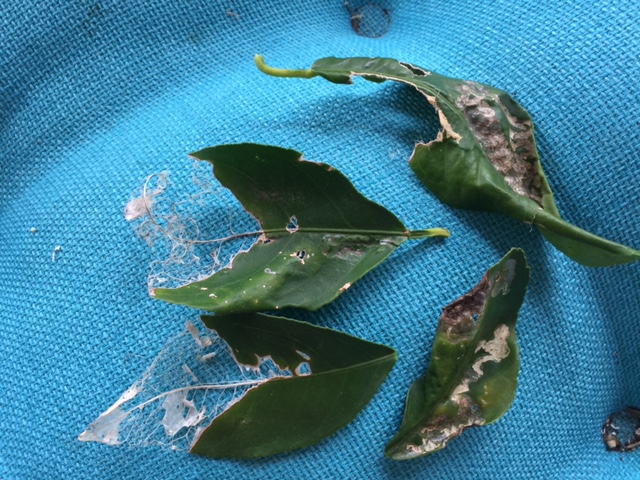
Q. What bug does this to my citrus trees? I’ll look up in your bug book if I knew what did it. C. N. New Braunfels, TX
A. Looks like the work of some type of caterpillar or sawfly. The same organic pesticides don’t necessarily work on both these insects. Insecticidal soap will work on both for low populations of young larvae. Bacillus thuringiensis (Bt) will kill the larvae (caterpillars) of butterflies and moths but will not control sawfly larvae. Trichogramma wasps will always be helpful for the caterpillars but not so much for the sawflies that do not turn into moths or butterflies. Their adult stage is a type of fly related to wasps and bees. The difference? Caterpillar’s head end is sometimes hard to tell from tail end. Caterpillars have fake eye spots (real eyes are microscopic) and the head is often not obvious. Sawfly eyes are easily visible and the head is obvious. Caterpillars have 3 true legs up front and then 5 or fewer pairs of prolegs which are fleshy extensions. Sawflies have the 3 pairs or true legs up front and 6 or more pair of the false legs toward the rear. Maybe more detail than you wanted but it’s interesting stuff. To kill the sawflies, use quality neem products, citrus-based products or spinosad. Spinosad products are probably the most effective on both these pests. However, spray spinosad surgically on the affected plants and not all over the entire garden. Spinosad is an excellent organic insect control but can disturb the navigation of beneficial pollinators such as honeybees.
Q. I was thinking of using one type of these trees for a privacy screen. Montezuma Cypress, Arizona cypress, Deodar cedar, Incense cedar, California incense cedar or Eastern red cedar but I’m worried my allergies will get worse (unless I try that new remedy you’ve been talking about). J.V. Melissa,TX
A. These trees are fine with a few exceptions. Montezuma cypress is a great shade tree but wouldn’t be that good for screening purposes. Arizona cypress is a very interesting and underused shade tree if you can find some good specimens in the nurseries. Deodar cedar is wide at the bottom and narrow at the top. It also has some disease and cold hardiness issues. Incense cedar is a terrific tree if you can find any to buy around these parts. Our native Eastern red cedar is an excellent choice for screening, especially if you can find female trees. They have the blue berries and not the male pollen that causes the allergies. I would strong recommend using a mixture of varieties rather than one. Having different types of trees creates a softer appearance and if any trees die, you aren’t rewarded with a “snaggle-tooth” effect. In addition to the ones you have mentioned, consider yaupon holly, cherry laurel, live oak and Chinese photinia. Adding some deciduous trees to the mix for spring and fall color might also be good. Consider Mexican plum, Mexican buckeye, redbud and rusty blackhaw viburnum.