
Moss, Ball & Spanish
SCIENTIFIC NAME: Tillandsia recurvata
FAMILY: Bromeliaceae (Bromeliad)
Ball moss (Tillandsia recurvata) is not a moss but an epiphyte (a plant or plant-like organism that grows on the surface of another plant). This plant is a Bromeliad, related to pineapples and the beautiful plants we use indoors. Ball moss is not a parasite but instead gets its nutrients from the sun and rain and dust that settles on it. It only hurts trees with heavy infestations but can be controlled easily by spraying baking soda or potassium bicarbonate at ½ cup per gallon of water. The same usually works on Spanish moss. Like mistletoe it does tend to attack trees as their health declines and the canopy thins.
Ball moss is physically supported by the trees where it grows, and if enough of it accumulates, the damage is done as it competes with the tree’s leaves for sunlight and by blocking areas where new branches would sprout.
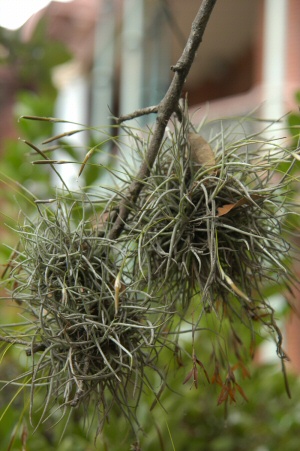
Ball moss only hurts the tree in heavy infestations but can be controlled easily by spraying the tree with a commercial product such as a Plant Wash (add 1/4 cup of baking soda or potassium bicarbonate per gallon of spray).
QUESTION: I have been told that Spanish moss growing on a large oak tree won”t affect the tree. I don’t believe that because my 40-foot-tall oak seems to be losing most of its leaves. What is happening, and how can I eliminate the moss while saving the tree? —R.B., San Antonio
ANSWER: At the very least, the presence of Spanish moss indicates a weakened tree. As the tree’s foliage thins, the moss grows thicker. That, in turn, inhibits new growth by the tree.
Use my Sick Tree Treatment, which begins with exposing the tree’s root flare. Physically remove as much moss as possible and spray the tree with a commercial product such as Plant Wash (add 1/4 cup of baking soda or potassium bicarbonate per gallon of spray).
More information from the Lady Bird Johnson Wildflower Center and Wikipedia.