
Swallowtail Butterfly
Tiger Swallowtail Butterfly
Papilio glaucas
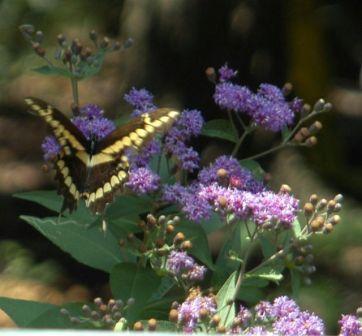 Giant swallowtail on ironweed |
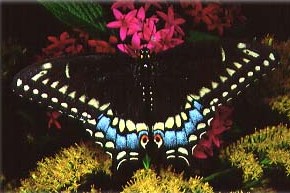 Black swallowtail |
Strong flier with distinctive yellow and black striped markings on its wings and body (some females are brown or black, mimicking the poisonous pipevine swallowtail). This relatively common butterfly has a wingspan of 3.5-6.5 inches
These butterflies are called swallowtails because they have long “tails” on their hindwings which look a bit like the long, pointed tails of swallows (a type of bird).
Egg: A butterfly starts its life as an egg. The female Tiger Swallowtail butterfly lays its spherical, yellow-green eggs on a leaf high in a tulip tree, sweet bay, wild black cherry, ash, lilac, aspen, birch, or choke cherry.
Caterpillar: The larva (caterpillar) hatches from an egg and eats the egg shell. Then it eats leaves (almost constantly). The newly-hatched larva is brown and white, and looks like bird droppings, but it turns green later. The caterpillar loses its old skin many times as it grows.<.p>
 The caterpillar is plump, smooth, and green with large yellow eyespots” that have black “pupils.” There is a yellow and black stripe where its “neck” should be. It grows to about 2 inches. Photo by Nadine Haefs |
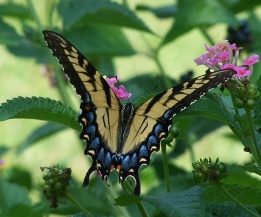 Adult: A beautiful, flying adult emerges. There is no growth during this stage, but the butterfly will sip nectar. This adult will continue the cycle by reproducing. Females produce two broods in the north, three in the south. photo by Suzann Goodman |
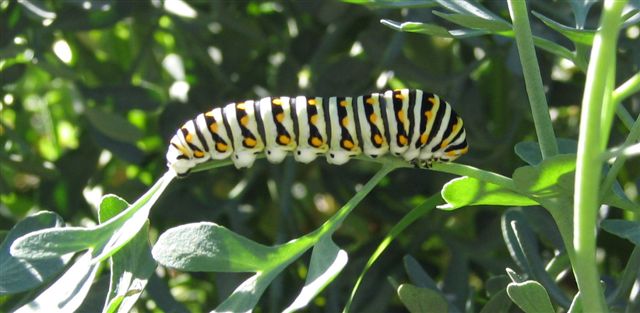 Black Swallowtail Photo by Nadine Haefs |
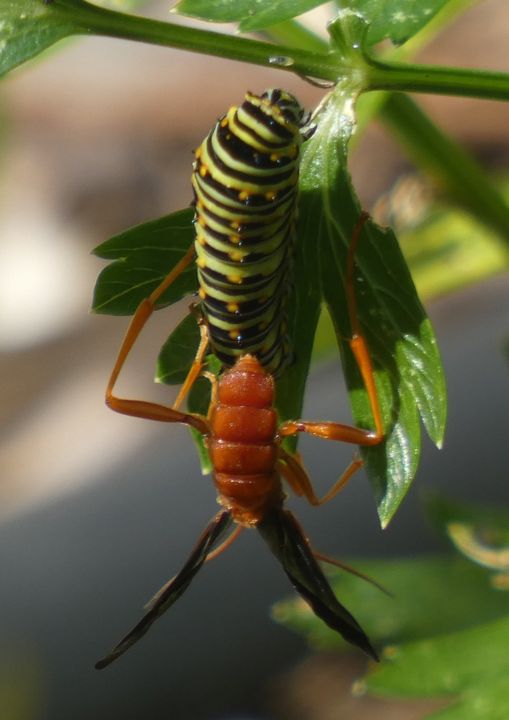 This photo of a wasp laying an egg in a black swallowtail caterpillar was captured in Baltimore, MD in September, 2021, by Rob Nease. Originally published in the Facebook group “Antman’s Hill.” |