
Dallas Morning News – March 18, 2021
Time to get the Spring Garden Started
Vegetable gardening is fun, good exercise and most importantly gives you assurance that the food you are eating really is organic, high in food value and free of toxic chemicals. Let’s cover some instructions for the beginners and fine tuning suggestions for the experienced. What I recommend actually gets easier the more we experiment and learn from our mistakes.
Forget removing and replacing the native soil. It is an important part of the bed preparation mix. Also forget the peat moss, pine bark and washed concrete sand. To have successful production the very first season, in short: add plenty of compost, organic fertilizer, rock minerals and sugars (microbe stimulators) into the native soil and mulch bare soil around growing plants.
Starting the project with a soil test can be helpful to fine tune your organic fertilizing, but if time doesn’t allow, the same bed preparation specs work for all soils – sand, loam, clay or any combination.
Start by scraping away existing weeds and grass and toss into the compost pile. Don’t have one? Well, let’s start one. Just pile the material up in some out of the way place. Even if you don’t maintain it well, discarded grass, weeds and other plant and animal waste will slowly turn into compost. Do this work before any tilling is done. Tilling first drives the reproductive part of the grasses and weeds down in the ground to be a problem forever. Organic herbicides (not the toxic stuff like Roundup) can be used, but physical removal of a couple of inches is still better.
Add amendments to the bare soil and till about 8 inches deep creating beds that are about 4′ wide with 18″ – 24″ walkways of mulch between the beds. Use 4″ – 6″ of compost, organic fertilizer (2 lbs. per 100 sq. ft.), lava sand (10 lbs. per 100 sq. ft.), Azomite (4 lbs. per 100 sq. ft.), dry molasses (2 lbs. per 100 sq. ft.) and whole ground cornmeal (2 lbs. per 100 sq. ft.). This creates a raised bed, but a wall isn’t really needed. Just carve the edges down at an angle.
 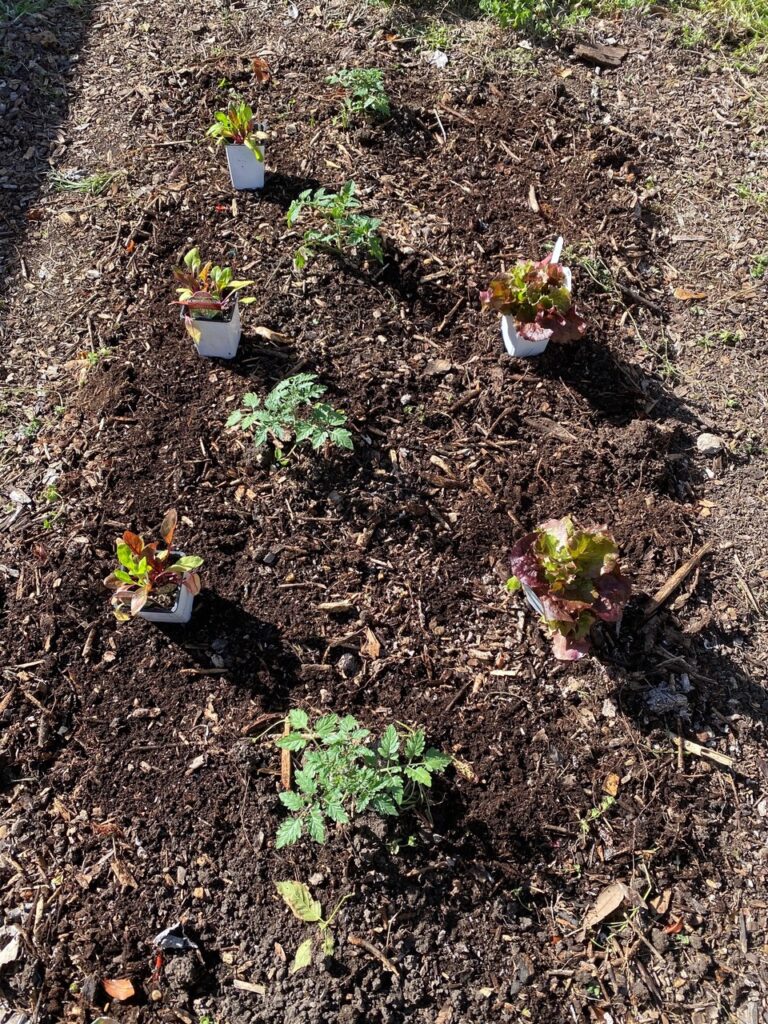 Tomatoes, Red Sails lettuce and Swiss chard being planted in 4′ wide beds prepared with native soil, compost, organic fertilizer, lava sand, dry molasses and cornmeal |
Moisten beds before planting – and make sure the roots of transplants are sopping wet before they are planted. If planting seeds, they should treated with Garrett Juice prior to planting. This speeds up and improves germination. Seeds can be soaked in a small dish or spritzed with a hand sprayer after being laid out paper.
Mulch beds with 2″ – 3″ of shredded native tree trimmings after planting transplants. Never pile mulch onto the stems of plants. Plants grown from seeds should be mulched after the plants start to grow.