

Callery and Bradford Pear Now Considered Invasive Trees
Organic Answers Column – January 25, 2023 – Callery Pear
Callery and Bradford Pear Now Considered Invasive Trees
In planning landscapes I have warned against Bradford pear trees for years, because of its short life and related problems, but have instead recommended Callery pear because of the better growth character and longer lifespan. It’s time to change that now and recommend that more states take the path that the State of Ohio has, banning the use of Callery Pear and their cultivars such as ‘Bradford’ pear, because they have become so invasive.
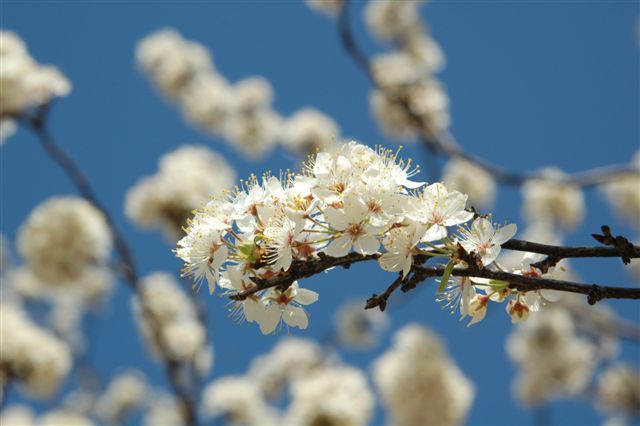
Bradford pear has prolific, if stinky, blooms.
Here’s the story of Ohio’s decision to ban the trees:
Last week a news story out of the University of Cincinnati reported on the work of Theresa Culley, Professor of Biological Sciences at the UC, who is a member of the Ohio Invasive Plant Advisory Committee and also serves on the State of Ohio’s Invasive Plants Council.
To put it bluntly, the Callery Pear has become an invasive nuisance. As she puts it in the introduction to her 2017 paper “The Rise and Fall of the Ornamental Callery Pear Tree,”:
The Callery pear, (Pyrus calleryana), and particularly its many cultivars such as ‘Bradford’, ‘Cleveland Select’, and ‘Aristocrat’, has become one of the most popular ornamental trees in North America. However, its commercial success has now become overshadowed by its tendency to spread along roadways and into natural areas through reseeding. Today this tree is considered invasive in many states, in stark contrast to how it grows in its native range in Asia.
The tree arrived via the USDA, when in the early 1900s, one of its plant explorers “sent hundreds of cuttings and thousands of pounds of seeds back to the USDA” from his explorations in Asia. One of these discoveries was the Callery pear, that grows in many soil types and conditions and the tree seed was collected in many regions of China from 1915-1919. The timing of this discovery seemed propitious because at the same time fire blight, a bacterial disease, had wiped out many of the pear tree orchards in the Pacific Northwest, where pears were an important crop. Experimentation moved forward because the Callery pear is resistant to fire blight. With marble-sized fruit it’s not good as a fruit crop, but excellent as rootstock because it was very hardy due to “its ability to endure diverse and adverse soil conditions.”
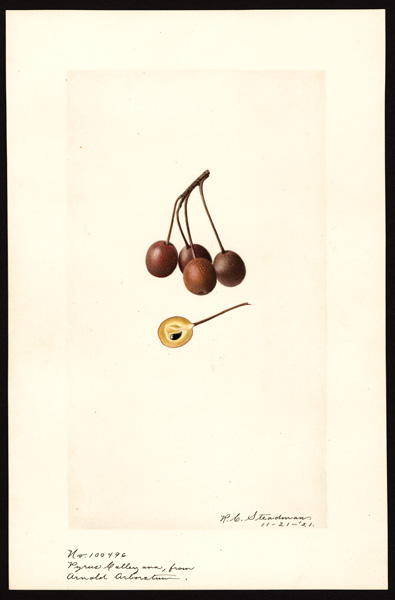
Callery Pear (fruit), 1921: USDA Pomological Watercolor Collection. Rare and Special Collections, National Agricultural Library, Beltsville, MD 20705
The seeds collected across China were planted at many US agricultural experimentation stations for observation and testing. As they matured they began to occasionally show interesting features. Scions (pencil-sized pieces of last year’s growth) from those trees were grafted onto other Callery rootstock and this is how the first cultivar, the Bradford pear, came to be. The Callery pear produces a thorn or spur, but cultivars were selected for features such as their lack of thorns or beautiful fall color, and were adopted as a fast-growing landscaping trees.
These sterile, fruitless cultivars were very popular. Pear trees can’t self-pollinate, and as long as the grafted trees near each other were genetically identical, no fruit was produced. But as different patented cultivars were planted near each other, they began to produce fruit and birds distributed the introduced pear trees into the American landscape. According to Culley:
“Seedlings of pear trees are now also showing up in the forest understory. They are very difficult to remove because they have a very long taproot,” Culley said.
[She] said the pear trees grow quickly and tolerate a variety of wet, dry, sunny or shady conditions.“They’re extremely hardy. They can grow pretty much anywhere. They have abundant flowers that attract all kinds of pollinators so they end up with abundant fruit that birds disperse.”
Several states are considering banning the trees. South Carolina and Pennsylvania will soon prohibit sales of the trees, according to the UC article.
So Bradford and Callery and other of these cultivars are off of the Dirt Doctor tree recommendation lists. As you find it necessary to remove the broken or diseased Bradford pear trees, find good native replacements to put in their place. Here is a list.
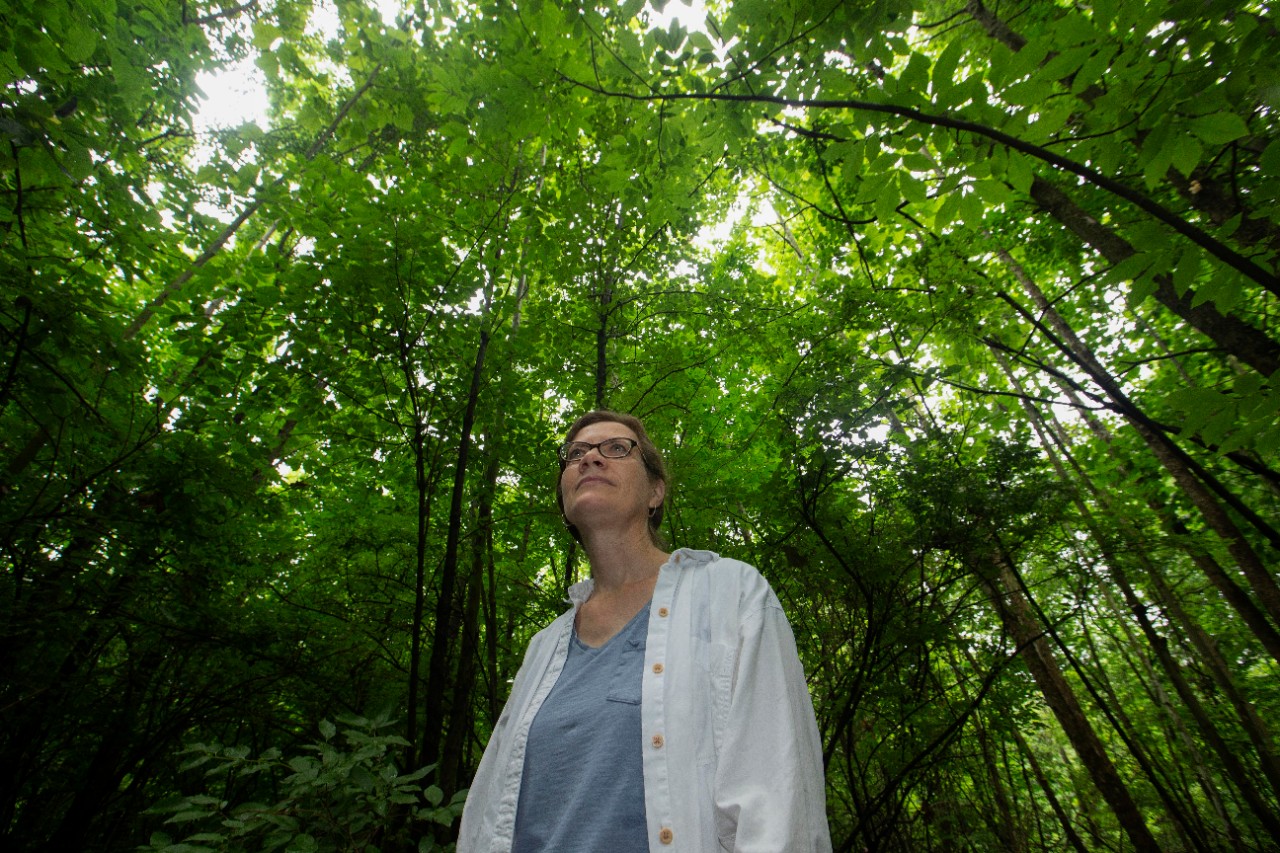
Theresa Culley, head of UC’s Department of Biological Sciences, stands in a grove of Callery pear trees at the Harris Benedict Nature Preserve. Photo/Joseph Fuqua II/UC
Professor Culley has published several papers on this subject, with a 2017 paper linked above. This most recent story from the University of Cincinnati was picked up by Treehugger, which has a fact-check feature that makes their article excellent for any kids wanting to write a science paper about the subject for school.